
Skip to content
Scan a barcode
Scan
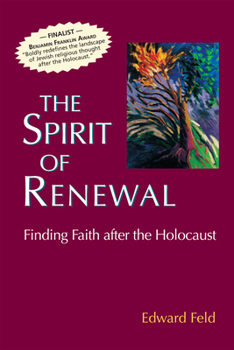
Paperback Spirit of Renewal Book

ISBN: 1879045400

ISBN13: 9781879045408

Spirit of Renewal

Select Format

Select Condition ThriftBooks Help Icon

Recommended

Format: Paperback

Condition: New

$14.56
Save $2.43!
List Price $16.99
Ships within 2-3 days
Save to List

Book Overview

Modernity has provided more than enough reason to give up believing in holiness, still we have learned that to give up the struggle to achieve it means that we become less human. As we leave the twentieth century, we discover new reasons to return to old faith. We rediscover an urgent need to defend the sacred, even as our understanding differs from our ancestors. We choose not to retreat from the world, but to struggle within it, to stain ourselves with sin even as we seek to establish the good.
-from Chapter 13, "Humanity"

The cataclysm of the Holocaust seems to forbid speech. Yet even in the heart of that darkness, sparks of sacredness were kept alive. From these sparks, Rabbi Edward Feld suggests, Jews and others can renew a faith and find a language that recovers the holy even after experiencing the reign of a Kingdom of Night unimaginable to previous generations.

In a voice that is engaging, often poetic, Rabbi Edward Feld helps the modern reader understand events that span almost 4,000 years of the history of Judaism and the Jewish people. With rare clarity, insight, and gentleness, he offers a thought-provoking yet accessible study of the way tragedy has shaped Jewish history and the self-understanding of Jews.

The Spirit of Renewal explores four key events that reshaped religious expression, two ancient and two modern: the Babylonian exile; the Bar Kochba revolution; the Holocaust; and the establishment of the State of Israel.

The Spirit of Renewal shows how, even under the most traumatic of circumstances, Judaism survives, renewing itself and flourishing again. This profound and wise meditation opens the way to a powerful new understanding of the nature of God and the spiritual life.

Customer Reviews

1 rating

Life After Death

Edward Feld's stirring book is an example of creative religious thinking for this new century basing itself on historical precedents, personal experience and contemporary theological insights. He is part of a generation that grew up with or immediately following the Holocaust and which sought to reclaim a spiritual life in the wake of the destruction of European Jewry. I am eight years younger than Rabbi Feld. His book resonated with me because we have many of the same generational experiences and yearnings. I took it with me when I escorted teenagers on the March of the Living and found that it provided a religious outlook which mirrored mine and enabled me to help frame both the Holocaust and the lived reality of the State of Israel for teenagers who would accept no false notes as they grappled with the core events of Jewish life in the 20th century.Feld traces a number of historical precedents to the radical evil of the Holocaust and examines the historical responses of previous generations to those events. Genesis, Job and Isaiah form the touchstones of Feld's exploration of Biblical theodocy. The loss of the Temple, the despair of that primary generation, subsequent responses of martyrdom and a rejection of this world and ultimately the replacement of history by timeless Torah are described by Feld as creating a theological paradigm which would persist and characterize Jewish life in subsequent centuries. If the Biblical responses to evil represent the early stage of Jewish theodocy and the rabbinic reactions form the "middle ages" of such a theology, the horror of the Holocaust and the miracle of the birth and continued existence of the State of Israel become the watershed of modernity.Feld rejects any simple effort to find meaning in the Shoah. I recall standing at the ashes of the crematoria with children of survivors who rejected the pablum offered them as an "explanation" of the Holocaust. Feld details the descent into hell and the effort to strip the Jew of both life and meaning. This leads to a radical critique of Jewish life and the notion of divine providence. He focuses on human efforts to remain faithful to life, what Fackenheim calls "kiddush hahayyim." That becomes the critical part of the rebuilding of a measure of faith after the Shoah. Rather like the rejection of Western civilization by Eliezer Berkovits, Feld sees our ideas of what humanity can be as transformed by the Holocaust - both for woe and for weal. Like most post-Holocaust thinkers, Feld is drawn away from the image of a transcendent God whose power and providence are everywhere to a more modest conception of God who is to be discovered in the small acts of those who clung to their ideals despite all efforts to degrade and dehumanize them. These acts are the "signs of transcendence" of which Peter Berger writes. Additionally, this returns Jewish life to a concern with history and away from an otherwordly orientation. The bi
Copyright © 2026 Thriftbooks.com Terms of Use | Privacy Policy | Do Not Sell/Share My Personal Information | Cookie Policy | Cookie Preferences | Accessibility Statement
ThriftBooks® and the ThriftBooks® logo are registered trademarks of Thrift Books Global, LLC

GoDaddy Verified and Secured