


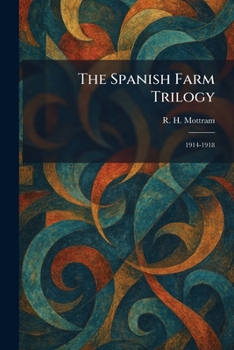
The Spanish Farm Trilogy: 1914-1918

"The Spanish Farm Trilogy 1914-1918" is a seminal work of British literature that captures the complex reality of life near the Western Front during the Great War. This comprehensive collection-comprising the novels "The Spanish Farm", "Sixty-Four, Ninety-Four ", and "The Crime at Vanderlynden's"-explores the intersection of military operations and civilian endurance. At the heart of the narrative is Madeleine Vanderlynden, a determined French farmer's daughter who manages her family's land amidst the persistent presence of British forces in Flanders.
R. H. Mottram provides a unique and sober perspective on the conflict, focusing not just on the frontline but on the logistical, social, and emotional tolls of prolonged warfare. The prose deftly balances the grit of military life with the stubborn persistence of the local peasantry, offering a nuanced portrait of a landscape and society transformed by the machinery of trench warfare. Recognized for its historical accuracy and literary merit, the trilogy remains a vital account of the human experience during one of the twentieth century's most devastating conflicts, portraying the resilience of individuals caught in the gears of global struggle.
This work has been selected by scholars as being culturally important, and is part of the knowledge base of civilization as we know it. This work was reproduced from the original artifact, and remains as true to the original work as possible. Therefore, you may see the original copyright references, library stamps (as most of these works have been housed in our most important libraries around the world), and other notations in the work.
This work is in the public domain in the United States of America, and possibly other nations. Within the United States, you may freely copy and distribute this work, as no entity (individual or corporate) has a copyright on the body of the work.
As a reproduction of a historical artifact, this work may contain missing or blurred pages, poor pictures, errant marks, etc. Scholars believe, and we concur, that this work is important enough to be preserved, reproduced, and made generally available to the public. We appreciate your support of the preservation process, and thank you for being an important part of keeping this knowledge alive and relevant.
Customer Reviews
ThriftBooks ® and the ThriftBooks ® logo are registered trademarks of Thrift Books Global, LLC
