


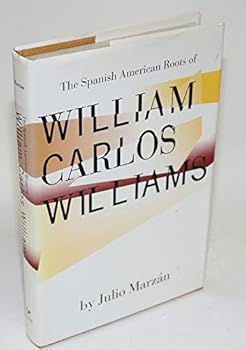
The Spanish American Roots of William Carlos Williams


As David Ignatow's foreword notes, the time is ripe for a multicultural canonical modernist, and Marzan himself, a poet with Puerto Rican roots, has produced an insightful study of Williams' sometimes hidden, sometimes obvious debt to his Spanish American heritage. At the same time, Marzan raises serious questions about how 'ethnic' literature shapes the modern canon. --American Literature I have been waiting for some time for a study of Williams's Latin American roots, and this book fills that bill. . . . It's a significant addition to the Williams canon. --Paul Mariani, author of William Carlos Williams: A New World Naked William Carlos Williams wrote from an all-encompassing American vision that recalls the spirit of Walt Whitman. Paradoxically, though, this most-American poet sprang from foreign roots--a Puerto Rican mother and a father who was an English-born Caribbean islander. In this poetically evocative work, Julio Marzan explores the Latin American roots of Williams' poetry. In particular, he focuses on the dualities and contradictions between Williams' public, North American persona, Bill, and his private, poetically encrypted Latin persona, Carlos. He shows how Williams' poetry draws on Latin American and Spanish sources, particularly the poetry of Spaniard Luis de Gongora, to encode a Latin subtext in poems that ostensibly present a mainstream, Anglo vision. These explorations uncover a wealth of complexity in Williams and his poetry. Reflecting the experience of many immigrants, his life and work embody the unreconcilable desires to assimilate and win acceptance in a new land while remaining separate and immersed in the beloved culture of one'sbirth. A published poet, Julio Marzan is also editor of Inventing a Word: An Anthology of Twentieth-Century Puerto Rican Poetry.
Format:Hardcover
Language:English
ISBN:0292751605
ISBN13:9780292751606
Release Date:August 1994
Publisher:University of Texas Press
Length:304 Pages
Weight:1.40 lbs.
Dimensions:9.5" x 1.0" x 6.5"
Customer Reviews
1 rating
Dusting Off the "Carlos" in "William Carlos Williams"
Published by Thriftbooks.com User , 17 years ago
THE SPANISH AMERICAN ROOTS has me wondering why it isn't more satisfying and persuasive, since its author, Julio Marzan, has wonderful excitement and knows his Williams like the back of his hand, always pulling out the exact right referent with which to back his argumentation. Every page has another fine quotation and an equally fine application, and one couldn't be more sympathetic to the author's cause, which makes perfect sense the more one thinks about it. Yet how does Williams' Spanish heritage manifest itself in his poetry? There Marzan has an uphill struggle on his hands. Emotionally it makes sense, since a lot of WCW's writing seems to operate on a double matrix, there's an Anglo rectitude Marzan identifies with WCW's father, "William George," and there's an extra element, something the skews the poetry into a previously unknown (in American poetry) range of modernism and Marzan pins this as the Puerto Rican strain, for Williams' mother was born and reared in Mayaguez. What makes it difficult for Marzan is that Williams only rarely acknowledges anything Spanish and when he does, it's almost always with that distant reach of the "other." "Those people." Himself as a "Gringo." It's hard to follow all of Marzan's arguments, mainly because one doesn't always want to go where he wants to go, i.e., tracking down all references to the "jungle" or the "fertile" or the "dark side" (the duende) in Williams' work and invariably he sees all these strains as the Spanish at work in WCW and it all starts to seem, if not reductive, then a bit retardataire, like saying Rita Hayworth was an appealing dancer because she was Mexican. In fact all the worst aspects of Williams, especially his sexual politics, become Puerto Rican in Marzan's reading and I don't know if he realizes how compromised his Latin American WCW becomes. No, I'm wrong there; he does appreciate how much his reading complicates our previously beneficent image of Williams, but again, the evidence is scant enough to make you think, maybe, maybe not. He says this is not a biography but rather a book that will aid the biographer of the future. May that writer come along who can shed light on Marzan's tantalizing hints. He's got the sizzle, but where's the steak?
Copyright © 2026 Thriftbooks.com Terms of Use
| Privacy Policy | Do Not
Sell/Share My Personal Information | Cookie Policy | Cookie Preferences | Accessibility Statement
ThriftBooks® and the ThriftBooks® logo are registered trademarks of Thrift Books Global, LLC
ThriftBooks® and the ThriftBooks® logo are registered trademarks of Thrift Books Global, LLC
