


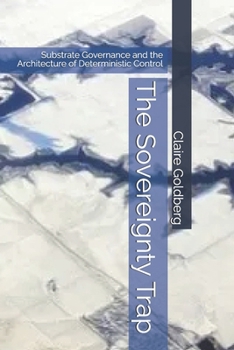
The Sovereignty Trap: Substrate Governance and the Architecture of Deterministic Control

The Sovereignty Trap argues that modern institutions-governments, enterprises, and public infrastructures-have been misled into believing that digital sovereignty depends on owning massive compute or renting foreign cloud intelligence. This belief creates a structural trap: organizations either surrender control to external execution engines or bankrupt themselves trying to replicate hyperscale infrastructure.
The book introduces Substrate Governance, a deterministic architectural model that separates the fluid, probabilistic workload (LLMs, agents, neural networks) from the immutable execution substrate-a local, air-gapped runtime boundary that enforces safety, compliance, and jurisdictional control through mathematical invariants rather than natural-language prompts.
Across four parts, the book demonstrates:
Why wrapper governance fails under acceleration, semantic drift, and multi-agent recursion.
How deterministic substrates anchor meaning, enforce typed states, validate invariants, and drop unsafe execution frames instantly.
How identity collapses in non-deterministic systems and must evolve into cryptographic provenance and behavioural boundaries.
How governance drift emerges, and why policy must be decoupled from model weights, prompts, and application code.
How deterministic circuit breakers, escalation tiers, and air-gapped continuity create resilient systems that survive cloud outages, adversarial prompts, and model drift.
How adversaries shift to substrate-level attacks, and how a sovereign substrate neutralizes injection, state pollution, timing side channels, and boundary probing.
How institutions can adopt substrate governance, reduce execution tax, contain liability, and treat sovereignty as a financial asset.
The core thesis is simple and uncompromising:
If you do not own the execution boundary, you do not own the system.
The Sovereignty Trap provides the architectural blueprint for reclaiming digital agency in a world dominated by non-deterministic AI workloads and foreign-controlled execution engines.
Customer Reviews
ThriftBooks ® and the ThriftBooks ® logo are registered trademarks of Thrift Books Global, LLC
