


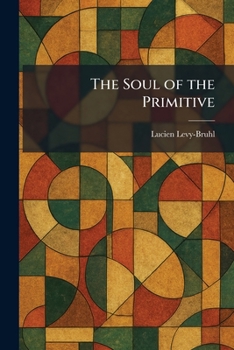
The Soul of the Primitive

"The Soul of the Primitive" is a seminal exploration into the cognitive and spiritual frameworks of indigenous societies. In this influential work, Lucien L vy-Bruhl delves into the concept of the individual within cultures he characterizes as having a distinct psychological and social orientation. Rather than viewing the human soul as a singular, isolated unit, the text examines how various cultures perceive identity through a lens of collective representation and mystical participation with the environment and the community.
The book investigates the complex relationships between the living and the dead, the significance of personal naming, and the rituals that define a person's status within their social group. By analyzing a wide array of ethnographic data, L vy-Bruhl challenges the conventional psychological models of his era, offering a profound look at how different human groups structure their reality and their sense of self. This work remains a cornerstone for students of anthropology, sociology, and the philosophy of mind, providing essential historical insights into the diversity of human thought and the evolution of social theory.
This work has been selected by scholars as being culturally important, and is part of the knowledge base of civilization as we know it. This work was reproduced from the original artifact, and remains as true to the original work as possible. Therefore, you may see the original copyright references, library stamps (as most of these works have been housed in our most important libraries around the world), and other notations in the work.
This work is in the public domain in the United States of America, and possibly other nations. Within the United States, you may freely copy and distribute this work, as no entity (individual or corporate) has a copyright on the body of the work.
As a reproduction of a historical artifact, this work may contain missing or blurred pages, poor pictures, errant marks, etc. Scholars believe, and we concur, that this work is important enough to be preserved, reproduced, and made generally available to the public. We appreciate your support of the preservation process, and thank you for being an important part of keeping this knowledge alive and relevant.
Customer Reviews
ThriftBooks ® and the ThriftBooks ® logo are registered trademarks of Thrift Books Global, LLC
