


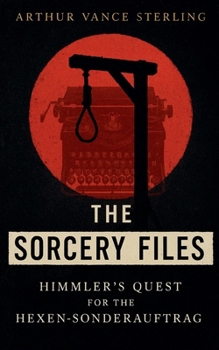
The Sorcery Files: Himmler's Quest for the Hexen-Sonderauftrag

Do we truly possess the past, or do we merely curate the ghosts we find most useful?
For the serious historian, the Third Reich is often viewed through the lens of steel and gunpowder-of Panzer divisions and diplomatic failures. But beneath the surface of the "Thousand Year Reich" lay a different kind of infrastructure, one built of parchment, ink, and a terrifyingly methodical obsession with the occult. In The Sorcery Files, Arthur Vance Sterling strips back the sensationalist veneer of "Nazi magic" to expose the cold, bureaucratic heart of the Hexen-Sonderauftrag. This was not a fringe hobby; it was a state-funded, massive archival operation that deployed SS researchers into the dusty basements of Europe to catalog the deaths of over 30,000 "witches." This book is not for the casual observer, but for the reader who demands to see the machinery of a myth as it is being manufactured.
The "Witch Special Assignment" was a project born from Heinrich Himmler's profound insecurity regarding German identity. By documenting the Great Burning of the medieval era, the SS sought to frame the Inquisition not as a religious event, but as a racial genocide against "Germanic wise women." Sterling's narrative takes you into the Hexen-Kartothek-a sprawling card index that transformed victims of the stake into data points for a new Aryan religion. You will sit at the desks of the H-Sonderauftrag researchers, men who balanced the clinical precision of a librarian with the fanatical zeal of a true believer, creating a paper fortress intended to shield the Reich from the influence of the Cross.
This is a journey into the "Archives of the Abyss," where every folder contains a life extinguished and a history rewritten. Sterling explores the tension between the academic elite and the occultists within the SS, revealing how looted Polish and Czech archives were scoured for "ancestral secrets" that could be weaponized at Wewelsburg Castle. You will discover the bizarre episodes of the project, such as the search for ancient herbalism and telepathy, which Himmler believed could be harvested to give his "Black Order" a biological and spiritual edge on the battlefield. It is an exploration of what happens when the state decides that the truth of the past is a commodity to be mined, refined, and redistributed as propaganda.
For those who seek to experience the past rather than just read about it, The Sorcery Files offers a visceral look at the "banality of the supernatural." It details the desperate 1945 scramble to hide these files in salt mines as the Red Army closed in, and the subsequent shock of Allied intelligence officers who found thousands of cards detailing 17th-century sorcery instead of 20th-century troop movements. Sterling's work is a masterclass in historical excavation, documenting how a modern totalitarian state attempted to reach back through time to claim the souls of the dead as citizens of their New Order.
If a regime can successfully rewrite its ancestors, is there any limit to what it can do to its living?
Customer Reviews
ThriftBooks® and the ThriftBooks® logo are registered trademarks of Thrift Books Global, LLC
