


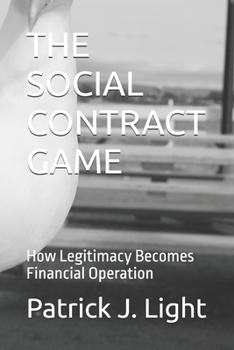
The Social Contract Game: How Legitimacy Becomes Financial Operation

THE SOCIAL CONTRACT GAME
How Legitimacy Becomes a Financial Obligation
Modern societies no longer run on shared belief.
They run on contracts - most of them unsigned.
The Social Contract Game examines how legitimacy, obligation, and stability are enforced in large-scale systems without moral consensus or ideological agreement. Rather than asking what the social contract should be, this book models how it already functions - quietly, mechanically, and at scale.
Drawing on game theory, economics, and systems design, the book explains why modern social contracts behave less like moral agreements and more like financial instruments: obligations that are renewed through recurring participation, repriced during crises, and enforced through access rather than force.
Inside, the book explores:
Why belief no longer scales as a coordination mechanism
How modern contracts operate without signatures or consent
Why legitimacy behaves like fixed income, not equity
How recurring contributions replace one-time gestures
What default and repricing look like in social systems
Why winners underwrite stability without controlling it
How enforcement works through permission rather than punishment
Why shocks reveal contracts instead of breaking them
This book does not argue for reform or redistribution. It does not assign blame or propose ideology. It accepts the modern system as it exists and explains why it persists.
The Social Contract Game is the fourth book in The Equilibrium Games series, following The Economic Reset Game, The Power Brokerage Game, and The Social Solution Game. Together, the series provides a unified framework for understanding modern power, stability, and equilibrium.
Customer Reviews
ThriftBooks ® and the ThriftBooks ® logo are registered trademarks of Thrift Books Global, LLC
