
Skip to content
Scan a barcode
Scan
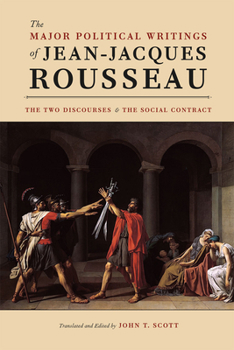
Hardcover The Social Contract and Discourses Book

ISBN: 1025990072

ISBN13: 9781025990071

The Social Contract and Discourses

Select Format

Select Condition ThriftBooks Help Icon

Recommended

Format: Hardcover

Condition: New

$34.95
Ships within 2-3 days
Save to List

Book Overview

"The Social Contract and Discourses" is a seminal collection of Jean-Jacques Rousseau's most influential political writings, serving as a foundational pillar of modern democratic thought and social theory. This volume brings together Rousseau's most critical inquiries into the human condition and the structure of governance, including "The Social Contract", "A Discourse on the Arts and Sciences", and "A Discourse on the Origin of Inequality".

In these works, Rousseau examines the transition of humanity from a state of nature to a structured civil society, famously asserting that while man is born free, he is everywhere in chains. He proposes that legitimate political authority rests on a social contract agreed upon by all citizens, emphasizing the concept of the "general will" as the ultimate source of sovereignty. His discourses further challenge the notion that progress in the arts and sciences has improved human morality, instead suggesting that societal advancement often masks deep-seated inequality and corruption.

With its profound exploration of individual liberty, collective responsibility, and the ethics of power, this collection remains essential reading for students of history, philosophy, and political science. Rousseau's visionary ideas continue to resonate in contemporary discussions regarding the rights of the individual and the role of the state.

This work has been selected by scholars as being culturally important, and is part of the knowledge base of civilization as we know it. This work was reproduced from the original artifact, and remains as true to the original work as possible. Therefore, you may see the original copyright references, library stamps (as most of these works have been housed in our most important libraries around the world), and other notations in the work.

This work is in the public domain in the United States of America, and possibly other nations. Within the United States, you may freely copy and distribute this work, as no entity (individual or corporate) has a copyright on the body of the work.

As a reproduction of a historical artifact, this work may contain missing or blurred pages, poor pictures, errant marks, etc. Scholars believe, and we concur, that this work is important enough to be preserved, reproduced, and made generally available to the public. We appreciate your support of the preservation process, and thank you for being an important part of keeping this knowledge alive and relevant.

Customer Reviews

5 ratings

Intellectual Godfather of the French Revolution

Jean-Jacques Rousseau's "The Social Contract and the Discourses" is composed of five essays, and together they show the radical nature of Rousseau's political thought as well as place Rousseau in the intellectual history of the West. To modern Western readers there is no denying the tragic failings of Rousseau's ideas, but there is also no denying the tragic power of his words. Rousseau's words would give birth to the French Revolution, and would help shape many dangerous revolutions after that. When Edmund Burke published "Reflections on the Revolution in France" in 1790, he was responding less to the tumult in France than to the political thought of Jean-Jacques Rousseau, twelve years after his death. If Rousseau were a student at today's Oxford or Harvard and he were to turn in any of his now famous political essays here's what his political science professor would write: "You make wildly unsubstantiated claims, and commit numerous logical fallacies, the two most egregious being circumlocution and inductive reasoning. Your paper digresses to the point of distraction. Overall, you rely too much on stirring people's sentiments rather than logically, thoughtfully arguing your thesis, which is more an emotional over-reaction than a nuanced and balanced synthesis of knowledge and experience. I will grant that you write superbly and with flourish. Make haste to transfer to the poetry major." Indeed, Rousseau is a master stylist, who saves a faulty and often nonsensical argument with the beauty of his style and the power of his conviction. There is a great joy in reading Rousseau's writing, for each sentence is pithy and pregnant with meaning, each paragraph a world onto itself. But that is also the dangerous evil in Rousseau: it is so easy to take his ideas and paragraphs out of context, with the consequence that his words would make concrete and focused one's otherwise directionless anger and fury. In his beautifully written essay "A Discourse on the Origin of Inequality," Rousseau harks back to man's natural state, where he is compassionate, virtuous, and just; in Rousseau's calibration, private property is what upsets the natural world of equality and destroys man's virtue. These ideas fuel the French Revolution, anticipate Marx, and tragically help shape the fanatical flattening of totalitarian communism. In "A Discourse on the Arts and Sciences," he praises the Spartans and early Romans for their simplicity and ignorance, which makes them steadfastly loyal to their equality and virtue. The arts and sciences in a society that is already corrupted by wealth and luxury (and in fact the arts and sciences could only flourish in a corrupt wealthy society, in Rousseau's worldview) only make the body politic that much more enervated and lethargic, prone to revolution or invasion. The most dangerous of all Rousseau's ideas can be found in his most famous essay "The Social Contract" (although oddly it is the most haphaza

Man is born free and everywhere lives in chains

I read this book for a graduate class in Philosophy. Jean Jacques Rousseau born (1712-1778), in Geneva mother dies in childbirth, he was an engravers apprentice. Stayed out too late one night and locked out of the city, knew he would get in trouble for it so he takes off for France, and meets Madame De Warrens becomes his lover and she converts him to Roman Catholicism. He had a lifelong mistress had 5 kids which he left with an orphanage, which is amazing considering he wrote the book "Emile," which was a guide to raising and educating young children. He neglected the opportunity to put theory into practice. To begin at the beginning, famous lines of book "The Social Contract," "Man is born free, and everywhere he is in chains." The question he asks, how do we find a way to get people to live together in groups? To live together in society and yet still make it true that each person only obeys himself that leaves us as free as when we were in the state of nature. He thinks he has the answer, he thinks he can legitimate, a kind of society, where people have this much freedom. There are certain things that he thinks are necessary for this, first, it has to be a society with general laws. It can't be that whoever is in charge of the government gets to do whatever they feel like doing. There has to of been laws made that authorize this. Second, there has to be universal consent to the laws, everybody has to accept the laws. Now this may be a little unclear, because there is a point that Rousseau talks about majority rule. It does make sense though there is a sense that he believes that the people have to consent to all of the laws, it has to be unanimous, it is just going to take a little while to get to that point. We will see how he reconciles these ideas. Third, there has to be unlimited Sovereignty, people have no rights against the laws you can't say the laws are illegitimate because they violate your rights the way that Locke would say for example people completely give up their rights to the collective. Therefore, there is no worry that a law might trespass on somebody's rights. For Rousseau, be sure to understand that this idea of sovereignty means the power to make laws. Therefore, it is a little bit different say than what you got out of Hobbes were he talks about the sovereign's power. For Hobbes, sovereign power is the power to say what goes. There is no real distinction between what we would call legislative power and executive power. You know the power to make the law and the power to enforce the laws. For Rousseau, sovereignty means the power to make the laws. Therefore, that's the power that is unlimited. Everything the state does has to be done in accordance to the laws. However, there is no limit on what the laws can be. At least no limits coming from the idea of violating individual rights. The only limit on the power of the state is the laws. There is this kind of notion that periodically there would be an assembly of people t

A masterpiece of political thought

The issues of liberty and democracy, monarchy and legitimacy, are never better explained that in The Social Contract by Rousseau. Rousseau explains every thought on to the page, from the most abstract thoughts of the ideal society to every day issues of Lobbying (which he finds a major detriment to society) and Suffrage (which Rousseau demands of society). The book is wonderfully written, every word is deliberate (I must pay my respect for the translator on such a splendid job) and shows how important understanding language is in order to understand the great ideas that are discussed by language. Liberals will see this book as a beautiful light of democracy, conservatives might see this book as proof of authoritarian beliefs. The truth is that both can be read in the book. Because the book not only conveys to the reader what Rousseau thinks, it inspires the reader to think for him or her self.

Good old days today

I first read the Social Contract back in college. Then, it was but one piece of philosophy/political writings out of many. I ran across the book again a few months ago and decided to give it a second reading. I was very happy that I did. In these uncertain times, the truth and role of government becomes cloudy. Rousseau's work helped to remind me that the government should serve the people and humanity in general. This is an idea that really seems to have been lost, especially under the Bush administration. Although I do not agree with everything Rousseau writes, I would recommend this work to anyone to read this and reflect on its modern context. "Man was born free, and he is everywhere in chains."

Brilliant ideas regarding a model society

Inspired by the unfair treatment of France by their king, J.J. Rousseau wrote this book and ideology based on the equality of men. In this book, Rousseau gives the reader detailed information on his view of the model society. The reader is consumed by the principle stating that no man has any authority over the other, and the balance of man's losses and gains gives the reader a sense of hope in this form of community. This is a must-read for any lover of deep thought and classic literature.
Copyright © 2026 Thriftbooks.com Terms of Use | Privacy Policy | Do Not Sell/Share My Personal Information | Cookie Policy | Cookie Preferences | Accessibility Statement
ThriftBooks ® and the ThriftBooks ® logo are registered trademarks of Thrift Books Global, LLC

GoDaddy Verified and Secured
