


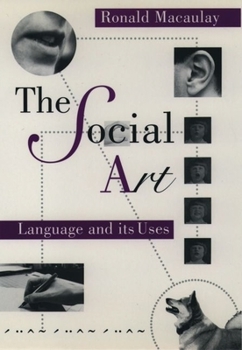
The Social Art: Language and Its Uses

Select Format
Select Condition 
Book Overview
This engagingly written, highly readable volume introduces lay readers to the fascinating world of language. Replete with jokes, anecdotes, quotations, and readily intelligible examples, it offers a painless entree to the full range of linguistic knowledge. In thirty-one brief chapters, Macaulay delves into such topics as language acquisition, phonology, morphology, syntax, semantics, social dialects, sex differences, writing, style, register, conversation, narrative, swearing, rhetoric, second language learning, and linguistic change. The reader comes away with a new appreciation of the pleasure to be derived from the study of this complex and uniquely human phenomenon.
Format:Paperback
Language:English
ISBN:0195106571
ISBN13:9780195106572
Release Date:April 1996
Publisher:Oxford University Press
Length:256 Pages
Weight:0.90 lbs.
Dimensions:6.2" x 0.7" x 9.3"
Customer Reviews
2 ratings
Good information. Most useful text in my Anthro 104 class
Published by Thriftbooks.com User , 24 years ago
I loved this book because it was easier to read than my other two Anthropology 104 textbooks, Language Shock: Understanding the Culture of Conversation and The workings of language.The best feature of this book is the glossary, which gives you meanings to some of the most used terms in the book. It has 33 chapters and it reads quickly like an elementary school english textbook.
highly approachable above all else
Published by Thriftbooks.com User , 26 years ago
This book is highly recommended for anyone interested in language or linguistics at any level of discipline. Macaulay's style is informative and approachable--how refreshing it is to read a book on the topic of language that utilizes an easily approachable one! The chapters are quite short but make their points and present their theories clearly and succinctly, never drudging out boring pedantry just to fill pages. His is a very down-to-earth style and approach to this often lofty topic.
Copyright © 2026 Thriftbooks.com Terms of Use
| Privacy Policy | Do Not
Sell/Share My Personal Information | Cookie Policy | Cookie Preferences | Accessibility Statement
ThriftBooks® and the ThriftBooks® logo are registered trademarks of Thrift Books Global, LLC
ThriftBooks® and the ThriftBooks® logo are registered trademarks of Thrift Books Global, LLC
