


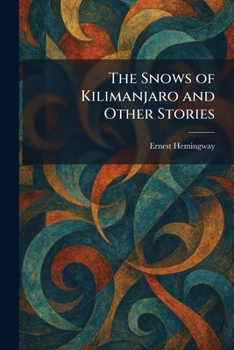
The Snows of Kilimanjaro and Other Stories


Select Format
Select Condition 
Book Overview
"The Snows of Kilimanjaro and Other Stories" is a seminal collection of short fiction that showcases the mastery of one of the twentieth century's most influential writers. Centered on themes of mortality, regret, and the pursuit of artistic integrity, the collection is anchored by its legendary title story. In it, a writer named Harry lies dying of gangrene while on an African safari, using his final moments to reflect on the experiences he never committed to paper and the life he squandered in pursuit of comfort.
The stories in this volume exemplify Hemingway's signature prose style-a minimalist, direct approach often referred to as the "iceberg theory." By focusing on the stark reality of the human condition, Hemingway explores the complexities of masculinity, the psychological scars of war, and the indomitable yet fragile nature of the human spirit. Whether set in the rugged landscapes of Africa or the quiet corners of Europe, these narratives capture the disillusionment of the "Lost Generation" with profound clarity. This collection remains an essential work of modern literature, providing an unflinching look at the struggles of men facing their own failures and the inevitability of death.
This work has been selected by scholars as being culturally important, and is part of the knowledge base of civilization as we know it. This work was reproduced from the original artifact, and remains as true to the original work as possible. Therefore, you may see the original copyright references, library stamps (as most of these works have been housed in our most important libraries around the world), and other notations in the work.
This work is in the public domain in the United States of America, and possibly other nations. Within the United States, you may freely copy and distribute this work, as no entity (individual or corporate) has a copyright on the body of the work.
As a reproduction of a historical artifact, this work may contain missing or blurred pages, poor pictures, errant marks, etc. Scholars believe, and we concur, that this work is important enough to be preserved, reproduced, and made generally available to the public. We appreciate your support of the preservation process, and thank you for being an important part of keeping this knowledge alive and relevant.
Related Subjects
Anthologies Classics Contemporary Fiction Literary Literature & Fiction Short StoriesCustomer Reviews
A Good Collection
Sort stories - about as good as they can get!
Beautiful, riveting short fiction from Mr. Hemingway!
The Greatest Short Story of All-Time
A quick fix of Hemingway.
ThriftBooks ® and the ThriftBooks ® logo are registered trademarks of Thrift Books Global, LLC
