


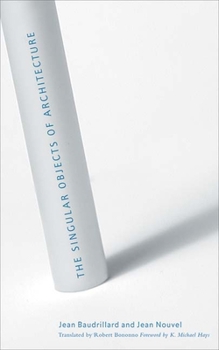
The Singular Objects of Architecture

Select Format
Select Condition 
Book Overview
What is a singular object? An idea, a building, a color, a sentiment, a human being. Each in turn comes under scrutiny in this exhilarating dialogue between two of the most interesting thinkers working in philosophy and architecture today. From such singular objects, Jean Baudrillard and Jean Nouvel move on to fundamental problems of politics, identity, and aesthetics as their exchange becomes an imaginative exploration of the possibilities of modern architecture and the future of modern life. Among the topics the two speakers take up are the city of tomorrow and the ideal of transparency, the gentrification of New York City and Frank Gehry's surprising Guggenheim Museum in Bilbao. As Nouvel prompts Baudrillard to reflect on some of his signature concepts (the virtual, transparency, fatal strategies, oblivion, and seduction, among others), the confrontation between such philosophical concerns and the specificity of architecture gives rise to novel and striking formulations--and a new way of establishing and understanding the connections between the practitioner and the philosopher, the object and the idea. This wide-ranging conversation builds a bridge between the fields of architecture and philosophy. At the same time it offers readers an intimate view of the meeting of objects and ideas in which the imagined, constructed, and inhabited environment is endlessly changing, forever evolving. Jean Baudrillard is one of the most influential thinkers of his generation and author of The Vital Illusion (2001). Jean Nouvel has designed buildings throughout the world, including the new Guthrie Theater in Minneapolis, and is a recipient of France's Grand Prix d'Architecture. Robert Bononno, a translator and teacher, lives in New York City.
Format:Paperback
Language:English
ISBN:0816639132
ISBN13:9780816639137
Release Date:November 2005
Publisher:University of Minnesota Press
Length:104 Pages
Weight:1.95 lbs.
Dimensions:0.3" x 5.0" x 8.1"
Customer Reviews
1 rating
It's a good idea to buy this text
Published by Thriftbooks.com User , 16 years ago
Every student of architecture is in some ways an auto-didact. I was doing research on a screen design and stumbled upon this tiny, easily dismissible work. I had read some of Baudrillard's previous work, which I found to be nihilistic and thick, like a stew with bits and pieces all the same size. I was never sure what to make of the man. I had known Nouvel from his works--the Cartier Foundation, the Guthrie, and Torre Agbar--but I had never gotten a taste of his philosophy. After reading this text for the second time recently, it only makes sense to add this book to the top-ten-lists of every architecture student in the world. It is very important. The issues that are discussed between the two include aesthetics of culture and of architecture, the disappearance of culture, the architecture of nothingness, censorship, structuralism, and general pontifications on current design trends breeding new perversions. Once the two get going, it really becomes interesting. I read pages 17 to 63 while drinking my morning coffee. Given the scope of ideas presented in this book, exhaustion is left as a task entirely for the reader. For 100 or so pages, depending on the edition of the book, there is room for many a discourse, and ultimately leaves the reader (me) wanting more and more. Consider it a very well composed appetizer cum entree. It should definitely be a required text for all NAAB accredited universities.
Copyright © 2026 Thriftbooks.com Terms of Use
| Privacy Policy | Do Not
Sell/Share My Personal Information | Cookie Policy | Cookie Preferences | Accessibility Statement
ThriftBooks® and the ThriftBooks® logo are registered trademarks of Thrift Books Global, LLC
ThriftBooks® and the ThriftBooks® logo are registered trademarks of Thrift Books Global, LLC
