


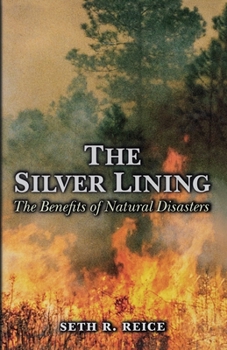
The Silver Lining: The Benefits of Natural Disasters.


Select Format
Select Condition 
Book Overview
Floods, fires, volcanic eruptions, earthquakes, hurricanes--we are quick to call them ''natural disasters.'' But are they? Did the great fires that swept Yellowstone in 1988 devastate the park, or did they just ravage our image of the park as a fixed, unchanging national treasure? This lucid, lively book reveals the shortsightedness behind conceiving of such events as disastrous to nature. Indeed, Seth Reice contends, such thinking has led to policies that have done the environment more harm than good--the U.S. Forest Service's campaign against natural forest fires and the Army Corps of Engineers' flood prevention program are examples. He points out ways in which we can better address the wide range of environmental problems humanity faces at the dawn of the new millennium. Reice argues, in terms refreshingly nontechnical yet scientifically sound, that the traditional, equilibrium paradigm--according to which ''stability'' produces healthier ecosystems than does sudden, sweeping change--is fundamentally flawed. He describes a radically different model of how nature operates, one that many ecologists and population biologists have come to understand in recent years: a concept founded on the premise that disturbances help create and maintain the biodiversity that benefits both the ecosystem and ourselves. Reice demonstrates that ecosystems need disturbances to accomplish indispensable tasks such as the production of clean air and water. He recommends changes in environmental management to incorporate the essential role of natural disturbances. This book shows that every tornado's funnel cloud, every forest fire's billowing cloud of smoke, has tremendous benefits for the ecosystem it impacts. As anyone concerned with man's impact on the environment will appreciate, this is the cloud's real silver lining.
Format:Hardcover
Language:English
ISBN:0691059020
ISBN13:9780691059020
Release Date:October 2001
Publisher:Princeton University Press
Length:240 Pages
Weight:1.00 lbs.
Dimensions:8.8" x 1.0" x 5.8"
Customer Reviews
1 rating
A More Realistic Model of Change in Natural Ecosystems
Published by Thriftbooks.com User , 19 years ago
This is a concise, very clear overview of the nonequilibrium dynamics in ecosystems -- why natural "disasters" are actually beneficial to the environment by encouraging biodiversity. The old, equilibrium models miss the fundamental role of the environment in species frequency and distribition -- see The Theory of Island Biogeography (E. O. Wilson) and The Song of the Dodo (David Quammen). While I thorougly enjoyed The Song of the Dodo as creative science writing, this drier and shorter volume provides a better basis for thinking about, and managing, our environment.
Copyright © 2026 Thriftbooks.com
Terms of Use | Privacy Policy | Do Not Sell/Share My Personal Information | Cookie Policy | Cookie Preferences | Accessibility Statement
ThriftBooks ® and the ThriftBooks ® logo are registered trademarks of Thrift Books Global, LLC
ThriftBooks ® and the ThriftBooks ® logo are registered trademarks of Thrift Books Global, LLC
