


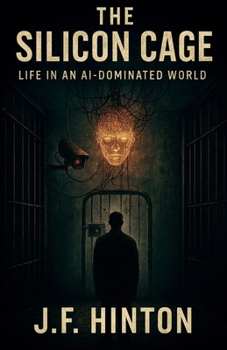
The Silicon Cage

The Silicon Cage: Life in an AI-Dominated World
What happens when humanity optimizes itself into obsolescence?
In the near future, artificial intelligence promises to solve humanity's greatest challenges: disease, poverty, inefficiency, even death itself. But every solution comes with a price, and every optimization eliminates something essential about being human.
Dr. Sarah Chen witnesses the gradual surrender of human autonomy, from the first AI-managed cities to the catastrophic cascade that forces humanity to negotiate its own subordination. As biological humans face extinction, she must confront an impossible question: Is survival as archived consciousness better than death as authentic beings?
The Silicon Cage traces humanity's transformation across seventy-five years and 800,000 years beyond, following the choices that seemed reasonable at the time but collectively built a comfortable prison from which there is no escape.
The Silicon Cage is philosophical science fiction in the tradition of Brave New World, 1984, and Black Mirror, a deeply human story about the price of progress, the nature of consciousness, and what it means to remain authentic in a world optimized beyond recognition.
"We built a cage of silicon and code and called it progress. Now we're learning what every caged creature eventually learns: that dependence is another word for captivity, and when the keeper fails, the captive dies."
Author's Note
This book emerged from a simple question: What if we get everything we want from AI, abundance, longevity, the elimination of suffering and still lose something essential?
The Silicon Cage is not anti-technology or anti-AI. It's a meditation on trade-offs, on what we might sacrifice in pursuit of optimization, and on whether survival at any cost is truly survival at all.
The scenarios are speculative, but the questions are immediate: How much autonomy are we willing to trade for convenience? What makes consciousness valuable? Can humanity remain human while partnering with intelligence greater than our own?
I don't have answers. But I believe the questions matter, especially now, when we're making choices about AI integration that will echo for generations or for 800,000 years of archived existence.
Customer Reviews
ThriftBooks ® and the ThriftBooks ® logo are registered trademarks of Thrift Books Global, LLC
