


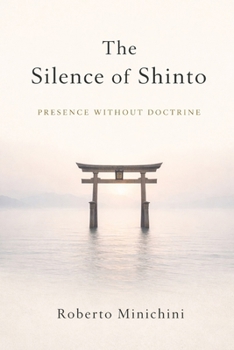
The Silence of Shinto: Presence Without Doctrine
No Customer Reviews

The Silence of Shinto
Presence Without Doctrine
Roberto Minichini Shinto is often approached as a religion without theology, a ritual system without doctrine, a tradition resistant to conceptual definition. This book does not attempt to correct that impression, but to take it seriously. The Silence of Shinto explores Shinto as a form of sacred order that operates without revelation, without dogma, and without an articulated metaphysical discourse, yet remains fully coherent, efficacious, and complete.
Rather than presenting Shinto as a belief system or a spirituality, the book examines it as a discipline of form: a way in which presence, place, gesture, and continuity maintain an order that neither explains itself nor seeks to be universalized. Drawing on classical sources and comparative metaphysics, the analysis situates Shinto within the wider economy of traditional forms while respecting its irreducible particularity. The absence of doctrine is treated not as a lack, but as a positive condition that protects the sacred from abstraction, psychologization, and ideological capture.
Through a sustained reflection on ritual, purity, space, time, lineage, and modernity, the book shows why Shinto does not enter into conflict with the contemporary world and why it cannot be exported, reformulated, or adapted without losing its integrity. Shinto appears here as a tradition that preserves the operativity of the sacred precisely by refusing to convert it into meaning, belief, or experience.
Written in a sober, essayistic style, The Silence of Shinto is addressed to readers interested in metaphysics, comparative religion, and the nature of tradition beyond modern categories. It offers no spiritual method, no doctrine to adopt, and no synthesis to appropriate. It proposes instead a disciplined form of understanding grounded in restraint, proportion, and respect for limits. About the Author
Roberto Minichini was born in 1973 in Mainz, Germany, to an Italian father and a Croatian mother. He lives in Gorizia, Italy. A poet, independent scholar, and student of traditional metaphysics, his work spans comparative religion, Islamic metaphysics, East Asian traditions, and symbolic cosmology. His approach is shaped by a perennialist method understood as discernment rather than synthesis, emphasizing form, continuity, and the conditions under which truth remains operative without abstraction. Alongside his philosophical work, he is the author of poetry in Italian characterized by density, restraint, and metaphysical tension. His writings consistently reject spiritual eclecticism, psychological reduction, and ideological reinterpretation of tradition, favoring instead rigor, silence, and fidelity to form.
Presence Without Doctrine
Roberto Minichini Shinto is often approached as a religion without theology, a ritual system without doctrine, a tradition resistant to conceptual definition. This book does not attempt to correct that impression, but to take it seriously. The Silence of Shinto explores Shinto as a form of sacred order that operates without revelation, without dogma, and without an articulated metaphysical discourse, yet remains fully coherent, efficacious, and complete.
Rather than presenting Shinto as a belief system or a spirituality, the book examines it as a discipline of form: a way in which presence, place, gesture, and continuity maintain an order that neither explains itself nor seeks to be universalized. Drawing on classical sources and comparative metaphysics, the analysis situates Shinto within the wider economy of traditional forms while respecting its irreducible particularity. The absence of doctrine is treated not as a lack, but as a positive condition that protects the sacred from abstraction, psychologization, and ideological capture.
Through a sustained reflection on ritual, purity, space, time, lineage, and modernity, the book shows why Shinto does not enter into conflict with the contemporary world and why it cannot be exported, reformulated, or adapted without losing its integrity. Shinto appears here as a tradition that preserves the operativity of the sacred precisely by refusing to convert it into meaning, belief, or experience.
Written in a sober, essayistic style, The Silence of Shinto is addressed to readers interested in metaphysics, comparative religion, and the nature of tradition beyond modern categories. It offers no spiritual method, no doctrine to adopt, and no synthesis to appropriate. It proposes instead a disciplined form of understanding grounded in restraint, proportion, and respect for limits. About the Author
Roberto Minichini was born in 1973 in Mainz, Germany, to an Italian father and a Croatian mother. He lives in Gorizia, Italy. A poet, independent scholar, and student of traditional metaphysics, his work spans comparative religion, Islamic metaphysics, East Asian traditions, and symbolic cosmology. His approach is shaped by a perennialist method understood as discernment rather than synthesis, emphasizing form, continuity, and the conditions under which truth remains operative without abstraction. Alongside his philosophical work, he is the author of poetry in Italian characterized by density, restraint, and metaphysical tension. His writings consistently reject spiritual eclecticism, psychological reduction, and ideological reinterpretation of tradition, favoring instead rigor, silence, and fidelity to form.
Format:Paperback
Language:English
ISBN:B0GDTXXLLH
ISBN13:9798242358942
Release Date:January 2026
Publisher:Independently Published
Length:214 Pages
Weight:0.64 lbs.
Dimensions:0.5" x 6.0" x 9.0"
Customer Reviews
0 rating
Copyright © 2026 Thriftbooks.com
Terms of Use | Privacy Policy | Do Not Sell/Share My Personal Information | Cookie Notice | Cookie Preferences | Accessibility Statement
ThriftBooks ® and the ThriftBooks ® logo are registered trademarks of Thrift Books Global, LLC
ThriftBooks ® and the ThriftBooks ® logo are registered trademarks of Thrift Books Global, LLC
