


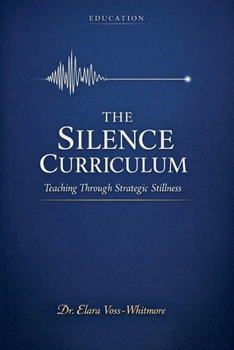
The Silence Curriculum: Teaching Through Strategic Stillness

What if the most powerful thing a teacher can do is say nothing?
Every day, in classrooms around the world, teachers talk for up to eighty percent of every lesson. They fill pauses, accelerate past confusion, and race through curricula designed to cover everything and consolidate nothing. Students arrive overstimulated, leave undertaught, and forget most of what was delivered before the weekend arrives. The system is loud, relentless, and producing exactly the learning outcomes the neuroscience would predict: shallow, fragile, and forgettable.
The Silence Curriculum is the book that changes this.
Drawing on a landmark five-year study involving forty-seven teachers and over three thousand students across four countries, cognitive education researcher Dr. Elara Voss-Whitmore reveals what the best science of learning has been telling us for decades and what most classrooms have refused to hear: the brain does its deepest, most durable work not during instruction, but in the quiet that follows it.
This is not a book about mindfulness. It is not a classroom management technique. It is a rigorous, practical, and deeply human argument for redesigning how we teach, built around five precisely defined types of strategic silence, each serving a distinct neurological purpose and each supported by decades of peer-reviewed research.
Inside, you will discover why extending a teacher's average wait time from under one second to just nine seconds increases the quality of student thinking by four hundred percent. You will learn how the brain's Default Mode Network, the very system suppressed by constant instruction, is responsible for memory consolidation, creative insight, and deep conceptual understanding. You will find complete lesson blueprints across mathematics, science, language arts, history, and the creative arts, along with protocols for neurodivergent learners, culturally diverse classrooms, and the particular challenges of online and hybrid learning environments.
The Silence Curriculum is written for classroom teachers who want to do better, for school leaders ready to build institutions where stillness is valued, and for anyone who has ever suspected that we are teaching too much and thinking too little.
The future of learning is quiet. This book shows you how to build it.
Customer Reviews
ThriftBooks ® and the ThriftBooks ® logo are registered trademarks of Thrift Books Global, LLC
