


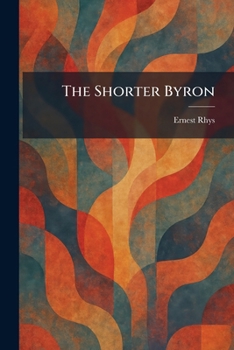
The Shorter Byron

"The Shorter Byron" is a thoughtfully curated anthology featuring the essential works of George Gordon Byron, one of the most influential figures of the Romantic movement. Edited by Ernest Rhys, this volume brings together the most significant poems, letters, and prose of a writer whose name became synonymous with passion, rebellion, and the "Byronic hero." Readers will find excerpts from Byron's epic masterpieces alongside intimate personal correspondence that reveals the complexity of his character and the depth of his literary genius.
From the satirical wit of "Don Juan" to the melancholic beauty of "Childe Harold's Pilgrimage," this collection captures the breadth of Byron's creative output. The selection highlights his mastery of form and his ability to articulate the profound emotions of longing, defiance, and philosophical inquiry. This volume serves as an ideal introduction for those new to his work while providing seasoned readers with a convenient compilation of his most enduring pieces. "The Shorter Byron" stands as a testament to the lasting impact of a poet who challenged the social and political conventions of his time, leaving an indelible mark on Western literature and the Romantic tradition.
This work has been selected by scholars as being culturally important, and is part of the knowledge base of civilization as we know it. This work was reproduced from the original artifact, and remains as true to the original work as possible. Therefore, you may see the original copyright references, library stamps (as most of these works have been housed in our most important libraries around the world), and other notations in the work.
This work is in the public domain in the United States of America, and possibly other nations. Within the United States, you may freely copy and distribute this work, as no entity (individual or corporate) has a copyright on the body of the work.
As a reproduction of a historical artifact, this work may contain missing or blurred pages, poor pictures, errant marks, etc. Scholars believe, and we concur, that this work is important enough to be preserved, reproduced, and made generally available to the public. We appreciate your support of the preservation process, and thank you for being an important part of keeping this knowledge alive and relevant.
Customer Reviews
ThriftBooks ® and the ThriftBooks ® logo are registered trademarks of Thrift Books Global, LLC
