


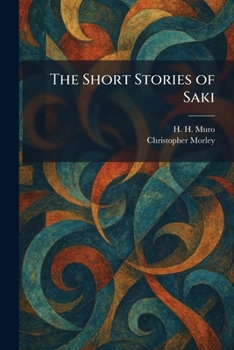
The Short Stories of Saki

"The Short Stories of Saki" is a definitive collection of the sharp, witty, and often macabre tales of H.H. Munro, better known by his celebrated pen name, Saki. Renowned for his biting satire and elegant prose, Munro masterfully skewers the rigid conventions and pretensions of Edwardian British society. His stories frequently feature rebellious youths, eccentric aristocrats, and the unexpected intrusion of the wild or the supernatural into the orderly drawing rooms of the upper class.
This volume showcases the full range of Saki's short fiction, highlighting his unique ability to blend dark humor with a keen understanding of human nature. From the subversive social maneuvering of Clovis Sangrail to the chilling psychological depth found in masterpieces such as "Sredni Vashtar" and "The Open Window," these stories remain as provocative and entertaining today as when they were first conceived. This collection, edited with an introduction by Christopher Morley, emphasizes the enduring literary significance of Munro's work.
By exploring the absurdities of social etiquette and the primal instincts lurking beneath a polite veneer, "The Short Stories of Saki" provides a quintessential reading experience for fans of classic literature and satirical fiction. This work stands as a testament to the power of the short story form to deliver both profound social commentary and delightful mischief.
This work has been selected by scholars as being culturally important, and is part of the knowledge base of civilization as we know it. This work was reproduced from the original artifact, and remains as true to the original work as possible. Therefore, you may see the original copyright references, library stamps (as most of these works have been housed in our most important libraries around the world), and other notations in the work.
This work is in the public domain in the United States of America, and possibly other nations. Within the United States, you may freely copy and distribute this work, as no entity (individual or corporate) has a copyright on the body of the work.
As a reproduction of a historical artifact, this work may contain missing or blurred pages, poor pictures, errant marks, etc. Scholars believe, and we concur, that this work is important enough to be preserved, reproduced, and made generally available to the public. We appreciate your support of the preservation process, and thank you for being an important part of keeping this knowledge alive and relevant.
Customer Reviews
ThriftBooks ® and the ThriftBooks ® logo are registered trademarks of Thrift Books Global, LLC
