





Book Overview
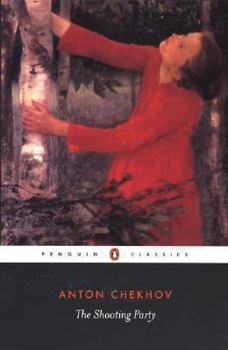
Anton Chekhov's only full-length novel, this Penguin Classics edition of The Shooting Party is translated and edited by Ronald Wilks, with an introduction by John Sutherland.
The Shooting Party centres on Olga, the pretty young daughter of a drunken forester on a country estate, and her fateful relationships with the men in her life. Adored by Urbenin, the estate manager, whom she marries to escape the poverty of her home, she is also desired by the dissolute Count Karneyev and by Zinovyev, a magistrate, who knows the secret misery of her marriage. When an attempt is made on Olga's life in the woods, it seems impossible to discover the perpetrator in an impenetrable web of lust, deceit, loathing and double-dealing. One of Chekhov's earliest experiments in fiction combines the classic elements of a gripping mysterywith a short story of corruption, concealed love and fatal jealousy. Ronald Wilks's brilliant new translation of this work is the first in over seventy years. It brilliantly captures the immediacy of the dialogue that Chekhov was later to develop into his great dramas. This edition also includes an introduction by John Sutherland, suggestions for further reading and explanatory notes. Anton Chekhov (1860-1904) was born in Taganrog, a port on the sea of Azov. In 1879 he travelled to Moscow, where he entered the medical faculty of the university, graduating in 1884. During his university years, he supported his family by contributing humorous stories and sketches to magazines. He published his first volume of stories, Motley Tales, in 1886, and a year later his second volume In the Twilight, for which he received the Pushkin Prize. Today his plays, including 'Uncle Vanya', 'The Seagull', and 'The Cherry Orchard' are recognised as masterpieces the world over. If you enjoyed The Shooting Party, you might like Chekhov's Plays, also available in Penguin Classics.Format:Paperback
Language:English
ISBN:0140448985
ISBN13:9780140448986
Release Date:September 2004
Publisher:Penguin Books
Length:224 Pages
Weight:0.43 lbs.
Dimensions:0.6" x 5.2" x 7.7"
Age Range:18 years and up
Grade Range:Postsecondary and higher
Customer Reviews
3 ratings
the roaring lake
Published by Thriftbooks.com User , 17 years ago
I enjoyed this novel a lot. The characters are generally dishonourable and the solution to who committed the crime is quite obvious (the editorial 'notes' were probably unnecessary for most readers). But there are surprises along the way. And, perhaps, an understanding that some personality disorders will have bad outcomes. Like all Russian writers Chekhov does employ some strong symbolic images, mostly of a negative kind. The dying woodcock at the shooting party was so strong for me. 'The girl in red', so central to the action, was less clear in her first appearance anyway. But the one that does stand out so strongly, so forbodingly, was the lake that at times 'roared' - I'm not actually sure how a lake can roar - perhaps it was in the mind of the narrator only. other recommendations: 'The Idiot' - Dostoevsky 'First Love' - Turgenev 'The Tartar Steppe' - Buzatti 'Solaris' - the film version of Lem's novel, produced by Tarkovsky
Impressive debut novel from Chekhov
Published by Thriftbooks.com User , 19 years ago
That Chekhov wrote this remarkable novel at the age of 24 is almost as impressive as Thomas Mann's writing of "Buddenbrooks" at the age of 26. "The Shooting Party" has a greater sense of feverish, almost Dostoyevskian intensity compared with Chekhov's later work, perhaps attributable to his youth. But it also has the same deep human understanding and descriptive ability - in Chekhov's almost minimalist style - as the later stories and plays. The structure of the story-within-a-story and the metamorphosis from provincial novel of manners to an account of sexual misconduct and moral turpitude (in 19th century terms) to detective story, all within the space of a 200 pages, may seem a little clumsy to a modern reader (and the identity of the murderer may also be a little more obvious now than it was to a contemporary reader), but achieving all of this in such a short novel takes a great deal of talent, and Chekov's great talent is apparent even at this early stage of his career. It is also a fascinating and compelling novel, both for its account of provincial Russian life, as well as the psychological portrayals of the characters and the "whodunnit" element. The previous review appears to refer to the 1926 translation (by Constance Garnett?), which no longer appears to be in print. This review relates to the new Ronald Wilks translation, which is adequate, though not outstanding. Constance Garnett's translations of Chekhov (which are still widely available) tend to be very readable and idiomatic (in English), if not always faithful to the original. Like many modern translations of Russian, this translation is occasionally a little wooden, and uses expressions or words that would generally not be used in English, reinforcing the fact that it is a translation. Not being fluent in Russian, I can't comment on its literal accuracy. However, despite these flaws, the translation conveys the story and the meaning of the text perfectly well. One area for criticism - as is often the case in Penguin classics - is that the notes are often intrusive (and occasionally unnecessary, although not nearly so bad as in other books), and I personally object to the appearance of footnotes within the text. I also object to the introduction - which gives far too much of the plot away - appearing at the beginning of the book, especially as so many readers insist on reading the introduction first. Personally, I would prefer to see critical comments appearing after the text of the novel.
Chekhov's Second Novel (or Only Novel? )
Published by Thriftbooks.com User , 20 years ago
Chekhov gained fame as the master of dozens of short stories and plays. Most of his works are set in small Russian towns and in the countryside. There is some debate on whether his two longer stories - this being one - are novels. The present novel is written in the same style as some of his short stories. For example, see "The Complete Short Stories" from Vintage Classics. The present story reminds the reader of "The Duel" and "The Story of an Unknown Man." Many consider it to be his second novel, or his only full novel. Compared to many well know novels by other authors it is short - just over 200 pages with the notes. It was written a few years after the time of his graduation from medical school in 1884. It was one of his first efforts in fiction and contains some elements of a mystery story with an element of comedy or farse. Chekhov is a little more subtle and human than his contemporary Dostoevsky and he did not write a 500 page novel. But one must admire both writers. In terms of setting and plot, the present work is closest to his other famous work the short story "The Duel" in flavour and setting. "The Shooting Party" has more drama than that short story, and it seems very informal almost slightly crazy; the characters drink a lot of vodka; it is a flamboyant story that takes place in rural Russia; and, the protagonist is a country detective or what they call investigating magistrate. In short, it is a bit of a wild tale. He uses the technique of placing a story within a story, and the two converge at the end. The Shooting Party, was translated into English in 1926 and Agatha Christie used parts in her mystery novel: "The Murder of Roger Ackroyd."
Copyright © 2026 Thriftbooks.com Terms of Use
| Privacy Policy | Do Not
Sell/Share My Personal Information | Cookie Policy | Cookie Preferences | Accessibility Statement
ThriftBooks® and the ThriftBooks® logo are registered trademarks of Thrift Books Global, LLC
ThriftBooks® and the ThriftBooks® logo are registered trademarks of Thrift Books Global, LLC
