


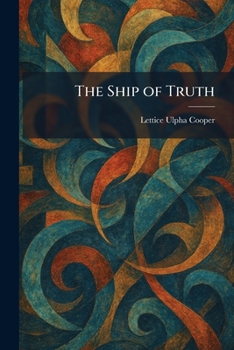
The Ship of Truth

"The Ship of Truth" is a profound exploration of spiritual crisis and the pursuit of intellectual integrity in the early 20th century. The narrative centers on Clement Dyson, a sincere young clergyman who finds himself increasingly at odds with the dogmas and institutional requirements of his church. As he grapples with the eroding foundations of his belief, Dyson must face the painful social and personal consequences of choosing honesty over professional and communal stability.
Set against a backdrop of shifting social values, Lettice Ulpha Cooper's novel delves into the psychological weight of religious doubt. Dyson's journey is not merely one of loss, but a search for a more authentic and enduring reality-a metaphorical "ship of truth" that can carry him through the uncertainties of modern life. Through sensitive characterization and thoughtful prose, the work examines the tension between tradition and conscience, highlighting the courage required to follow one's convictions regardless of the cost.
A notable contribution to the genre of the religious novel, "The Ship of Truth" remains a compelling study of a man's quest for meaning and the universal struggle to reconcile inherited faith with personal experience.
This work has been selected by scholars as being culturally important, and is part of the knowledge base of civilization as we know it. This work was reproduced from the original artifact, and remains as true to the original work as possible. Therefore, you may see the original copyright references, library stamps (as most of these works have been housed in our most important libraries around the world), and other notations in the work.
This work is in the public domain in the United States of America, and possibly other nations. Within the United States, you may freely copy and distribute this work, as no entity (individual or corporate) has a copyright on the body of the work.
As a reproduction of a historical artifact, this work may contain missing or blurred pages, poor pictures, errant marks, etc. Scholars believe, and we concur, that this work is important enough to be preserved, reproduced, and made generally available to the public. We appreciate your support of the preservation process, and thank you for being an important part of keeping this knowledge alive and relevant.
Customer Reviews
ThriftBooks ® and the ThriftBooks ® logo are registered trademarks of Thrift Books Global, LLC
