


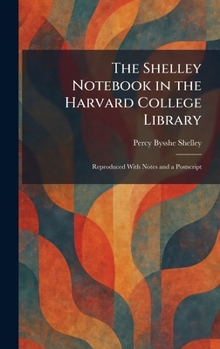
The Shelley Notebook in the Harvard College Library: Reproduced With Notes and a Postscript

"The Shelley Notebook in the Harvard College Library" offers a profound glimpse into the creative process of one of the most influential figures of the Romantic era, Percy Bysshe Shelley. This volume presents a reproduction of one of Shelley's personal notebooks, providing scholars and admirers of English literature an intimate look at the drafts, revisions, and raw inspirations that shaped his legendary verse. Accompanied by meticulous notes and an insightful postscript, the work contextualizes the manuscript within the poet's broader body of work.
The notebook contains early versions of poems and fragments that reveal the evolving thought of a literary genius. It serves as both a primary source for textual criticism and a testament to the enduring legacy of the Romantic movement. Readers can explore the intersection of personal reflection and poetic mastery, making it an essential resource for those interested in 19th-century literature, manuscript studies, and the life of Percy Bysshe Shelley. By examining these primary documents, the reader gains a deeper appreciation for the technical craft and philosophical depth inherent in "The Shelley Notebook in the Harvard College Library."
This work has been selected by scholars as being culturally important, and is part of the knowledge base of civilization as we know it. This work was reproduced from the original artifact, and remains as true to the original work as possible. Therefore, you may see the original copyright references, library stamps (as most of these works have been housed in our most important libraries around the world), and other notations in the work.
This work is in the public domain in the United States of America, and possibly other nations. Within the United States, you may freely copy and distribute this work, as no entity (individual or corporate) has a copyright on the body of the work.
As a reproduction of a historical artifact, this work may contain missing or blurred pages, poor pictures, errant marks, etc. Scholars believe, and we concur, that this work is important enough to be preserved, reproduced, and made generally available to the public. We appreciate your support of the preservation process, and thank you for being an important part of keeping this knowledge alive and relevant.
Customer Reviews
ThriftBooks ® and the ThriftBooks ® logo are registered trademarks of Thrift Books Global, LLC
