


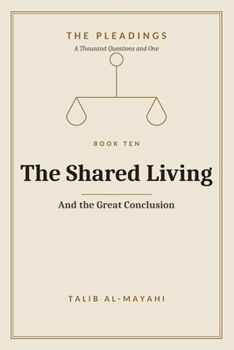
The Shared Living: and the Great Conclusion
No Customer Reviews

Nine volumes tried a claim. This one asks what is owed to the people of that claim once the trial is over, and then turns the same balance upon the house of the author himself. One hundred and twenty-seven questions, in four divisions. The first settles the living together from the governing root and from the practice: that no compulsion falls in religion; that what is owed to those who do not make war is kindness and justice, the hinge of enmity being the deed and no the belief; the writ of Medina; the inviolability of monasteries, churches, synagogues and mosques alike; the sharing of the table and of marriage; and the courtesy of disputing in the manner which is best. The second runs the balance upon the establishment in history, in four sweepings out, upon one hinge held to the end: what an establishment approved as a creed or by a decree is tried, and the deed of an adherent is not. The sword raised in the name of religion, from 1099 by the pen of their own historian to the courts of the Inquisition, the Ebionites, the wars of the sects, the expulsions and the blood accusation, and the Shoah established from the archive of the doers. The ranking of men by race made holy, from the decrees of enslaving to the theology of segregation. The trade in salvation, from the selling of pardon to the trading in relics. The fourth sweeping out is the one still open, and its heaviest documents belong to the author himself: the enacted law. Blasphemy statutes, in seventy-nine countries and territories in 2019, and in eighteen of the twenty countries of one region. A penal code that designates a community by a name not its own and forbids it the naming of its mosque and of its call to prayer. Apostasy laws in twenty-two states, and, where no penal section exists at all, a marriage annulled, a child moved, an inheritance forfeited. And, turned the other way about, statutes titled for the freedom of religion in which a threat of divine displeasure is force in law and the accused must prove his own innocence. Ten questions carry nothing but the balance upon us. One sets down the discipline that governs the whole: that no name for a people is taken from the mouth of its adversary nor from the pen of its victor. What could not be established was not printed, and the refusals are printed in its place. A count is dated and never called present. A trend the counter itself disowns is refused. No roster of the states that kill for a word is given, because the answer is two, three or seven to three different questions. The third division sets down what the same history bears of meeting: al-Andalus, the House of Wisdom, and the giving of the lie to the claim of a clash of civilizations. The fourth gathers the thousand, and closes with a word to every reader: that we are of one origin, that our tongues and colours were given for the knowing of one another, and that whoever is not a brother in religion is one like us in the creation; and that the offering of what one holds to be true is the best gift a brother has to give a brother, for exactly so long as it is offered and no imposed. Three hundred and three notes carry two hands: the note of the author in full, and beneath it what the collation established and against which edition. Not one note tells the reader that something was not collated. Book Ten, and the last, of The Pleadings: A Thousand Questions and One. Book One: Rules of Court. Book Two: The Trinity. Book Three: The Hypostatic Union and the Two Natures. Book Four: The Incarnation and the Redemption. Book Five: Justice, Prophecy, the Announcements, and the Return. Book Six: The Holy Book (the Gospels). Book Seven: The Gospels Taken as Four. Book Eight: The Canon, the Signifying and the Events. Book Nine: The Case Resumed.
Format:Paperback
Language:English
ISBN:B0HKFFMH69
ISBN13:9798172452208
Release Date:September 2026
Publisher:Independently Published
Length:402 Pages
Weight:1.18 lbs.
Dimensions:0.8" x 6.0" x 9.0"
Customer Reviews
0 rating
Copyright © 2026 Thriftbooks.com
Terms of Use | Privacy Policy | Do Not Sell/Share My Personal Information | Cookie Notice | Cookie Preferences | Accessibility Statement
ThriftBooks ® and the ThriftBooks ® logo are registered trademarks of Thrift Books Global, LLC
ThriftBooks ® and the ThriftBooks ® logo are registered trademarks of Thrift Books Global, LLC
