


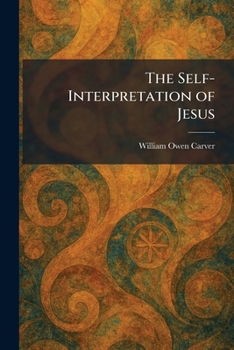
The Self-Interpretation of Jesus

"The Self-Interpretation of Jesus" by William Owen Carver is a profound theological study that delves into the consciousness and self-understanding of Jesus Christ as presented in the New Testament. Rather than focusing solely on external historical accounts or later ecclesiastical doctrines, Carver meticulously examines the words and actions of Jesus to discern how he viewed his own messianic mission, his relationship with the Father, and his purpose on earth.
This scholarly work offers a comprehensive analysis of the Gospels, seeking to bridge the gap between historical criticism and personal faith. Carver explores the depth of Jesus's identity, addressing key themes such as the Kingdom of God, the Son of Man, and the redemptive nature of Christ's ministry. By prioritizing Jesus's own perspective, the author provides readers with a clearer understanding of the foundational claims of Christianity.
Considered a significant contribution to early 20th-century Christology, "The Self-Interpretation of Jesus" remains a valuable resource for students of theology, biblical scholars, and anyone interested in the internal logic of the life of Jesus. Carver's insightful commentary illuminates the complexities of the biblical text, making it an essential read for those seeking to understand the core of the Christian faith through the eyes of its central figure.
This work has been selected by scholars as being culturally important, and is part of the knowledge base of civilization as we know it. This work was reproduced from the original artifact, and remains as true to the original work as possible. Therefore, you may see the original copyright references, library stamps (as most of these works have been housed in our most important libraries around the world), and other notations in the work.
This work is in the public domain in the United States of America, and possibly other nations. Within the United States, you may freely copy and distribute this work, as no entity (individual or corporate) has a copyright on the body of the work.
As a reproduction of a historical artifact, this work may contain missing or blurred pages, poor pictures, errant marks, etc. Scholars believe, and we concur, that this work is important enough to be preserved, reproduced, and made generally available to the public. We appreciate your support of the preservation process, and thank you for being an important part of keeping this knowledge alive and relevant.
Customer Reviews
ThriftBooks ® and the ThriftBooks ® logo are registered trademarks of Thrift Books Global, LLC
