


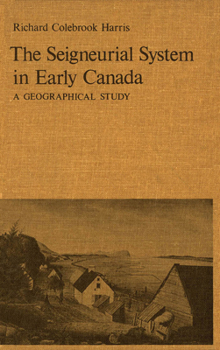
The Seigneurial System in Early Canada: A Geographical Study
No Customer Reviews

Select Format
Select Condition 
Book Overview
With its long thin fields and straggling rows of farmhouses stretching along either bank of the St Lawrence river for two hundred miles and more, the landscape of rural Canada toward the end of the French regime presented a distinctive charm and drew later writers to construct idyllic portraits of the social and legal system which, they believed, had shaped it. This was the seigneurial system of land tenure, whose legal structure was transferred alsmot unaltered from France to the New World. Although the system was old and effete in seventeenth-century France, scholars have considered that it shaped much of the life of early Canada. Harris argues in this classic study, now available in paper for the first time, that such was not the case. If the seigneurial system were central to the development of early Canadian society, the patterns of settlement, land use, and trade in the colony would have borne the imprint of the system. Through inspection of such records as deeds of land concession and sale, statements of vassalage, and wills, Harris reconstructs the geography of Canada before the British conquest. This evidence leads to novel and interesting conclusions: that the seigneurie was not an important unit on the land and the seigneur was not a dominant figure in the life of the community. With remarkable clarity, Harris unfolds a detailed picture of the landscape of early Canada and of the people who created it. The reissue of this important volume will be welcomed by all interested in early European societies in North America.
Format:Paperback
Language:English
ISBN:0773504346
ISBN13:9780773504349
Release Date:June 1984
Publisher:McGill-Queen's University Press
Length:247 Pages
Weight:0.10 lbs.
Dimensions:0.8" x 6.2" x 9.3"
Customer Reviews
0 rating
Copyright © 2026 Thriftbooks.com Terms of Use
| Privacy Policy | Do Not
Sell/Share My Personal Information | Cookie Policy | Cookie Preferences | Accessibility Statement
ThriftBooks® and the ThriftBooks® logo are registered trademarks of Thrift Books Global, LLC
ThriftBooks® and the ThriftBooks® logo are registered trademarks of Thrift Books Global, LLC
