


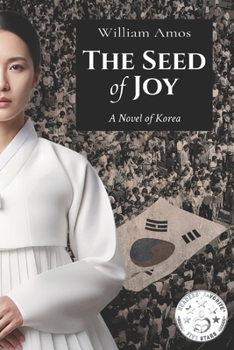
The Seed of Joy: A Novel of Korea

What happens when two people fall in love just as their country is falling apart?
South Korea, 1979.
American Peace Corps volunteer Paul Harkin arrives in the provincial city of Mokpo expecting to teach, serve, and experience a culture worlds away from his home in Indiana. Instead, he finds himself drawn into a Korea he barely understands-and into the life of Han Mi Jin, a fiercely independent young English teacher whose commitment to democracy puts her at odds with the authoritarian government that controls her country.
What begins with Korean language lessons soon becomes something far more personal. Paul and Mi Jin fall in love as the political world around them grows increasingly dangerous. Demonstrations erupt. Students challenge the government. Soldiers and police fill the streets. And the shadow of President Park Chung-hee's authoritarian rule hangs over everyday life.
Then, in October 1979, Park is assassinated.
For a brief moment, Koreans dare to hope that freedom may finally be within reach. Instead, a new military power rises. Martial law tightens its grip. Political leaders are arrested. Universities become battlegrounds. And the young people of South Korea discover that demanding democracy can carry a terrible price.
As Paul struggles to understand where his loyalties lie-and Mi Jin risks everything for the future of her country-their love becomes inseparable from the turbulent history unfolding around them. Their journey takes them from the streets and tearooms of Mokpo and Gwangju to the terrifying days of May 1980, when the people of Gwangju rise against military rule in what becomes known as the Gwangju Uprising or May 18 Democratization Movement.
But The Seed of Joy is not simply a novel about political violence or Korean history.
It is a love story.
It is a story about young people growing up, making mistakes, discovering courage, and learning what it means to love another person when the world around them is demanding impossible choices. And it is a deeply personal portrait of South Korea at a pivotal moment in its history, drawn from the author's own experiences as an American Peace Corps volunteer living there during the years leading up to and including Gwangju.
For readers who loved the sweeping historical storytelling of Min Jin Lee's Pachinko, the emotional intensity of Han Kang's Human Acts, or the Korean historical drama and romance of the K-drama ** Youth of May**, The Seed of Joy offers another intimate window into a Korea rarely seen from the inside. And for readers who were moved by the film ** A Taxi Driver**, this novel offers a very different perspective on the same extraordinary historical moment: not the story of one journalist's journey into Gwangju, but the story of two people whose love and lives become entangled in the struggle for Korean democracy.
Historical fiction. Korean history. South Korea. Korean culture. Historical romance. Political fiction. Love and war. Democracy movement. Gwangju Uprising. May 18 Democratization Movement. 1980 Gwangju. Peace Corps Korea. Military dictatorship. Korean political history. Korean historical novel.
The Seed of Joy: A Novel of Korea is for readers who want more than a romance-and more than a history lesson.
It is a story of love in dangerous times, courage in the face of fear, and hope born from the deepest kind of trouble.
Sometimes history changes a country. Sometimes it changes two people forever.
Open The Seed of Joy and enter the Korea of 1979-a country standing on the edge of transformation, and a love story standing on the edge of everything.
Customer Reviews
ThriftBooks ® and the ThriftBooks ® logo are registered trademarks of Thrift Books Global, LLC
