


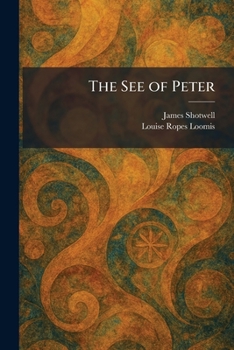
The See of Peter

"The See of Peter" is an authoritative historical examination of the origins and rise of the papacy within the early Christian church. James Shotwell and Louise Ropes Loomis provide a comprehensive collection of primary sources and scholarly analysis that trace the development of the Petrine doctrine and the institutional emergence of the Roman See. By exploring the scriptural, legendary, and historical foundations of the Bishop of Rome's authority, the work offers an in-depth look at how the church transitioned from a persecuted sect to a central power in Western civilization.
The volume meticulously organizes documents from the first five centuries of the Christian era, offering readers direct access to the texts that shaped ecclesiastical tradition. It addresses the textual evidence regarding Saint Peter's presence in Rome and the subsequent theological justifications for papal supremacy. "The See of Peter" remains an essential resource for students of medieval history, theology, and the evolution of religious institutions, providing a balanced and rigorous look at the transformation of the Roman church during late antiquity.
This work has been selected by scholars as being culturally important, and is part of the knowledge base of civilization as we know it. This work was reproduced from the original artifact, and remains as true to the original work as possible. Therefore, you may see the original copyright references, library stamps (as most of these works have been housed in our most important libraries around the world), and other notations in the work.
This work is in the public domain in the United States of America, and possibly other nations. Within the United States, you may freely copy and distribute this work, as no entity (individual or corporate) has a copyright on the body of the work.
As a reproduction of a historical artifact, this work may contain missing or blurred pages, poor pictures, errant marks, etc. Scholars believe, and we concur, that this work is important enough to be preserved, reproduced, and made generally available to the public. We appreciate your support of the preservation process, and thank you for being an important part of keeping this knowledge alive and relevant.
Customer Reviews
ThriftBooks ® and the ThriftBooks ® logo are registered trademarks of Thrift Books Global, LLC
