


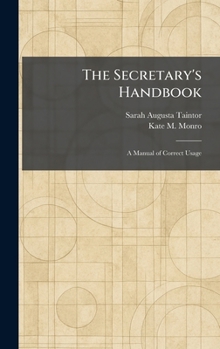
The Secretary's Handbook: A Manual of Correct Usage

Select Format
Select Condition 
Book Overview
"The Secretary's Handbook a Manual of Correct Usage" is an authoritative guide designed to provide comprehensive instruction on the standards of professional communication and office management. Written by Sarah Augusta Taintor and Kate M. Monro, this work serves as a definitive resource for individuals seeking to master the nuances of business English, formal correspondence, and administrative procedures.
The handbook covers a wide array of topics crucial for professional excellence, including correct grammar, punctuation, and spelling. It offers detailed guidance on the preparation of various business documents, such as letters, reports, and minutes of meetings. Beyond mechanical accuracy, the text delves into the principles of effective writing, ensuring that every communication is clear, concise, and professional. With its focus on practical application, the manual also addresses the proper forms of address for officials and the organization of professional records.
As a foundational text in the field of office administration, "The Secretary's Handbook a Manual of Correct Usage" emphasizes the importance of precision and decorum in the workplace. It remains a valuable reference for anyone dedicated to maintaining high standards in business correspondence and professional conduct.
This work has been selected by scholars as being culturally important, and is part of the knowledge base of civilization as we know it. This work was reproduced from the original artifact, and remains as true to the original work as possible. Therefore, you may see the original copyright references, library stamps (as most of these works have been housed in our most important libraries around the world), and other notations in the work.
This work is in the public domain in the United States of America, and possibly other nations. Within the United States, you may freely copy and distribute this work, as no entity (individual or corporate) has a copyright on the body of the work.
As a reproduction of a historical artifact, this work may contain missing or blurred pages, poor pictures, errant marks, etc. Scholars believe, and we concur, that this work is important enough to be preserved, reproduced, and made generally available to the public. We appreciate your support of the preservation process, and thank you for being an important part of keeping this knowledge alive and relevant.
Customer Reviews
ThriftBooks ® and the ThriftBooks ® logo are registered trademarks of Thrift Books Global, LLC
