


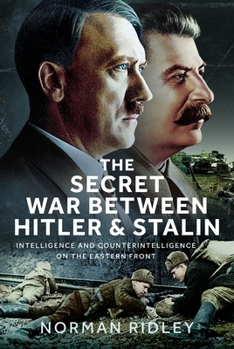
The Secret War Between Hitler and Stalin: Intelligence and Counterintelligence on the Eastern Front
No Customer Reviews

"...covers the various kinds of intel and counter-intel, including radio intercepts, agents, Luftwaffe overflights, and other aspects of gathering information." - Historical Miniatures Gaming Society
The intelligence war between Germany and the Soviet Union, ignited by Operation Barbarossa on 22 June 1941, was fiercely contested over four years. Neither side was prepared for the scale of the conflict, and both quickly developed methods to assess and counter each other's military intentions.
This book explores the intelligence strategies of Stalin's SMERSH and Hitler's Abwehr. SMERSH coordinated three independent counter-intelligence agencies within the Red Army, while the Abwehr was Germany's military-intelligence service. Focusing on key battles like Stalingrad and Kursk, the book examines how both sides competed for intelligence advantage.
The Soviets excelled in strategic deception, manipulating German decision-making. Early in the war, they used counterintelligence to deceive the Germans, notably during their surprise counteroffensive at Moscow in December 1941 and their hidden tank formations in 1942. German intelligence chief Gehlen underestimated Soviet deception and overestimated German superiority, which hindered effective analysis.
Meanwhile, the Soviets deployed agents behind German lines and employed terror tactics to destroy German operations. The pivotal battle of Stalingrad revealed the Germans' intelligence failures, and their subsequent losses marked a turning point. By the war's end, Soviet counterintelligence had become a critical weapon, reshaping the intelligence landscape and significantly impacting the outcome of the war.
The intelligence war between Germany and the Soviet Union, ignited by Operation Barbarossa on 22 June 1941, was fiercely contested over four years. Neither side was prepared for the scale of the conflict, and both quickly developed methods to assess and counter each other's military intentions.
This book explores the intelligence strategies of Stalin's SMERSH and Hitler's Abwehr. SMERSH coordinated three independent counter-intelligence agencies within the Red Army, while the Abwehr was Germany's military-intelligence service. Focusing on key battles like Stalingrad and Kursk, the book examines how both sides competed for intelligence advantage.
The Soviets excelled in strategic deception, manipulating German decision-making. Early in the war, they used counterintelligence to deceive the Germans, notably during their surprise counteroffensive at Moscow in December 1941 and their hidden tank formations in 1942. German intelligence chief Gehlen underestimated Soviet deception and overestimated German superiority, which hindered effective analysis.
Meanwhile, the Soviets deployed agents behind German lines and employed terror tactics to destroy German operations. The pivotal battle of Stalingrad revealed the Germans' intelligence failures, and their subsequent losses marked a turning point. By the war's end, Soviet counterintelligence had become a critical weapon, reshaping the intelligence landscape and significantly impacting the outcome of the war.
Format:Hardcover
Language:English
ISBN:1036122107
ISBN13:9781036122102
Release Date:August 2025
Publisher:Frontline Books
Length:256 Pages
Weight:1.15 lbs.
Dimensions:0.9" x 6.1" x 9.3"
Customer Reviews
0 rating
Copyright © 2026 Thriftbooks.com Terms of Use
| Privacy Policy | Do Not
Sell/Share My Personal Information | Cookie Policy | Cookie Preferences | Accessibility Statement
ThriftBooks® and the ThriftBooks® logo are registered trademarks of Thrift Books Global, LLC
ThriftBooks® and the ThriftBooks® logo are registered trademarks of Thrift Books Global, LLC
