


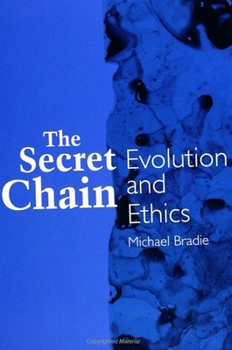
The Secret Chain: Evolution and Ethics

Select Format
Select Condition 
Book Overview
A philosophical exploration of how Darwinian evolution reshapes our understanding of morality, human nature, and ethical life.
How should we understand morality considering evolution? Does Darwinism undermine ethics--or deepen it? In this ambitious and wide-ranging study, Michael Bradie offers the first sustained philosophical examination of the relationship between evolutionary ethics and evolutionary epistemology.
Drawing on centuries of thought--from eighteenth-century British moralists to contemporary debates--Bradie brings analytic clarity to a field often marked by confusion and controversy. He carefully distinguishes the assumptions and methods of evolutionary theory and moral philosophy, illuminating where they converge, where they conflict, and where they are too easily conflated.
Engaging major thinkers such as Michael Ruse, Robert J. Richards, R. D. Alexander, E. O. Wilson, and Peter Singer, Bradie reconstructs and evaluates competing approaches to:
- Altruism, benevolence, and self-love
- The concept of human nature
- Sociobiology and the biological basis of morality
- Darwinism and the moral status of animals
- The philosophical implications of evolutionary theory for ethics
More than a historical survey, The Secret Chain advances a powerful original thesis about the biological roots of morality and the continuing relevance of Darwin for moral philosophy. Bradie's balanced, self-critical approach avoids simplistic reductionism while refusing to ignore the profound challenges posed by evolutionary science.
Customer Reviews
ThriftBooks® and the ThriftBooks® logo are registered trademarks of Thrift Books Global, LLC
