


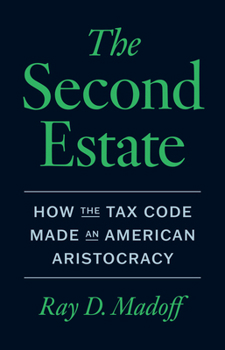
The Second Estate: How the Tax Code Made an American Aristocracy

Named by The New Yorker as one of the Best Books of 2025
A revelatory book that lifts the curtain on America's most consequential public deception: how the rich get richer using tools the government gave them.
Amid conflicting narratives about the drivers of wealth and inequality in the United States, one constant hovers in the background: the US tax code. No political force has been more consequential--or more utterly opaque--than the 7,000-page document that details who pays what in American society and government. Most of us have a sense that it's an unfair system. But does anyone know exactly how it's unfair? Legal scholar Ray D. Madoff knows. In The Second Estate, she offers an unprecedented look behind the scenes of America's byzantine system of taxation, laying bare not only its capacity to consolidate wealth but also the mechanisms by which it has created two fundamentally separate American societies: the working Americans who pay and the ultra-rich who benefit. This is not a story of offshore accounts or secret tax havens. In The Second Estate, Madoff shows that the US system itself has, over time, been stripped and reconstituted such that it now offers a series of secret paths, hidden in plain sight, for wealthy people in the know to avoid taxation altogether. Through the strategic avoidance of traditional income, leveraging of investments and debt, and exploitation of rules designed to promote charitable giving, America's wealthy do more than just pay less than their share; they remove themselves from the tax system entirely. Wealth becomes its own sovereign state, and the living is surprisingly--and maddeningly--cheap.Format:Hardcover
Language:English
ISBN:0226835200
ISBN13:9780226835204
Release Date:October 2025
Publisher:University of Chicago Press
Length:192 Pages
Weight:0.95 lbs.
Dimensions:0.9" x 5.6" x 8.6"
Customer Reviews
1 rating
A really, really important book
Published by Marsden , 3 months ago
In "The Second Estate," Prof. Ray Madoff shines a light on possibly the darkest secret of American economy, society, and politics: the very wealthy, who control so much of our economy and more and more of our politics every year, are largely exempt from the taxes that keep the country going.
There are a few reasons for this.
Some of them are fairly obvious: dividends and realized capital gains are taxed at much lower rates than salaries and wages, for example.
But probably the more important reason is that much of the income of the very wealthy isn't even recognized as income: unrealized capital gains and gifts and inheritances.
On top of this are special rules that only apply to the wealthy regarding deductibility of "charitable" donations, rules that allow them to offset much of any actually taxable income they may have.
The result of this has been to create dynasties of wealth, where -- contrary to the expressed intents of the founders of the country -- wealthy families convey their advantages across generations.
And today, because of this, our national politics in America are very much like a tennis match played between different billionaires.
Copyright © 2026 Thriftbooks.com Terms of Use
| Privacy Policy | Do Not
Sell/Share My Personal Information | Cookie Policy | Cookie Preferences | Accessibility Statement
ThriftBooks® and the ThriftBooks® logo are registered trademarks of Thrift Books Global, LLC
ThriftBooks® and the ThriftBooks® logo are registered trademarks of Thrift Books Global, LLC
