


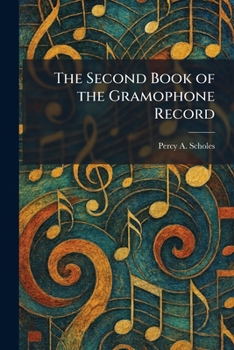
The Second Book of the Gramophone Record

"The Second Book of the Gramophone Record" is a foundational work in the field of music appreciation, designed to guide the listener through the expanding world of recorded classical music. Written by the esteemed music critic Percy A. Scholes, this volume serves as an expert companion to the major works of the orchestral and operatic repertoire available on early twentieth-century recordings. From the lyrical Romanticism of Mendelssohn to the groundbreaking modernism of the 1920s, Scholes provides detailed analysis and historical context for a wide array of compositions.
The work focuses on enhancing the listener's experience by breaking down complex musical structures into accessible insights. By exploring the nuances of masterpieces by composers such as Wagner, Verdi, Debussy, and Strauss, Scholes bridges the gap between the casual auditor and the serious student of music. The text highlights the educational potential of the gramophone, an instrument that revolutionized the accessibility of fine art by bringing the concert hall into the private home.
Historical and literary in its scope, this book remains a vital resource for understanding the evolution of musical taste and the early days of the recording industry. It is an essential read for music historians, record collectors, and anyone interested in the art of active listening.
This work has been selected by scholars as being culturally important, and is part of the knowledge base of civilization as we know it. This work was reproduced from the original artifact, and remains as true to the original work as possible. Therefore, you may see the original copyright references, library stamps (as most of these works have been housed in our most important libraries around the world), and other notations in the work.
This work is in the public domain in the United States of America, and possibly other nations. Within the United States, you may freely copy and distribute this work, as no entity (individual or corporate) has a copyright on the body of the work.
As a reproduction of a historical artifact, this work may contain missing or blurred pages, poor pictures, errant marks, etc. Scholars believe, and we concur, that this work is important enough to be preserved, reproduced, and made generally available to the public. We appreciate your support of the preservation process, and thank you for being an important part of keeping this knowledge alive and relevant.
Customer Reviews
ThriftBooks ® and the ThriftBooks ® logo are registered trademarks of Thrift Books Global, LLC
