


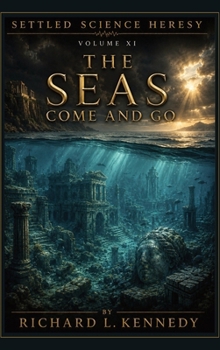
The Seas Come and Go

For most of human history, the sea was not a fixed boundary. It advanced and retreated, swallowed coastlines, exposed plains, redirected rivers, buried settlements, and forced whole communities to move. The familiar maps of today are only a moment in a much longer story.
In The Seas Come and Go, Richard L. Kennedy follows the evidence left behind by those changing waters: Doggerland beneath the North Sea, Sundaland beneath Southeast Asia, the drowned landscapes of the Gulf of America, the Bering land bridge, the Laurentide Ice Sheet, the Younger Dryas, and the submerged coastlines that may have sheltered some of humanity's earliest communities.
The journey moves from the great ice-age melt to G bekli Tepe, Derinkuyu, Baalbek, ancient flood traditions, early civilizations, and the recurring human effort to make sense of a world that would not hold still. What did people remember when rising water erased the places where their ancestors had lived? What evidence remains beneath modern seas? And how much of the accepted story of civilization rests upon the assumption that the oldest human landscapes were always where they are now?
Kennedy then turns to the present climate narrative. He distinguishes between the measured reality of change and the profitable industry built around the promise of permanent crisis. Sea levels have risen and fallen. Temperatures have shifted. Forests, ice, species, coastlines, and human societies have adapted-or disappeared. The question is not whether reality changes. It always has. The question is whether we are being taught to understand that change honestly.
The Seas Come and Go is Volume 11 of the Settled Science Heresy series. It is an invitation to look again at the world beneath the waves, the evidence beneath settled assumptions, and the stories we tell ourselves about the future.
Customer Reviews
ThriftBooks ® and the ThriftBooks ® logo are registered trademarks of Thrift Books Global, LLC
