


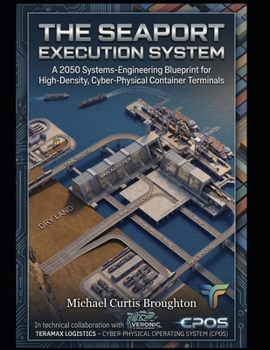
The Seaport Execution System: A 2050 Systems-Engineering Blueprint for High-Density, Cyber-Physical Container Terminals

The Great Material Disconnect
Global trade relies on Ultra-Large Container Vessels to move goods, yet these high-velocity pipelines stall at outdated seaports. While logistics technology has evolved, marine terminals remain frozen in the 1960s, stacking containers up to six high in open-air yards. This Last-In-First-Out (LIFO) model forces slow gantry cranes into wasteful "digging" shuffles to retrieve buried freight. This friction causes massive truck idling, exposes cargo to harsh weather, increases energy use, and strains power grids.
Adapting Retail Logistics to Heavy Freight
The solution requires adapting Fortune 50 retail systems-like those of Amazon and Walmart-to maritime trade. Retail networks eliminated LIFO bottlenecks by using automated high-bay racks where every item is individually accessible. By treating containers as heavy industrial pallets and storing them in an indoor Rack-Supported Building Automated Storage and Retrieval System (AS/RS), terminals give every container direct random-access addressability. Structural frame pins bear the load, completely eliminating rehandling shuffles.
Purpose, Structure, and Empirical Foundation
This volume presents the Seaport Execution System (SES), a blueprint for converting legacy terminals into automated indoor hubs. Framed by The VERONIC Reference Standard, it integrates systems engineering, smart microgrids, multi-modal flows, and cybersecurity, backed by Model-Based Systems Engineering simulations across 27 parameters:
Part I: Outlines the outdoor stacking crisis, SES transition, VERONIC standards, and microgrid governance.
Part II: Details the indoor AS/RS rack architecture, shuttle kinematics, 4D path reservations, and predictive staging.
Part III: Replaces quay cranes with Hybrid Continuous Over-Berth Bridges to service standard ships.
Part IV: Addresses landside interfaces, including automated portals, electric tractor fleets, megawatt charging, and rail links.
Part V: Covers sensor fusion, digital twin forensics, civil rack engineering, software architecture, and a 36-month deployment plan.
Part VI: Stress-tests the system via Monte Carlo simulations across five operational tiers, enforcing cybersecurity controls and mathematical validation rules.
A Vision for 2050
Transitioning to the Seaport Execution System yields a +66.2% increase in container velocity, 100% elimination of rehandling shuffles, a 75.0% smaller land footprint, a 57.2% cut in energy use, and a 75.3% reduction in carbon emissions-delivering an empirically verified blueprint for continuous, zero-emission flow. -Michael Curtis Broughton
Customer Reviews
ThriftBooks ® and the ThriftBooks ® logo are registered trademarks of Thrift Books Global, LLC
