


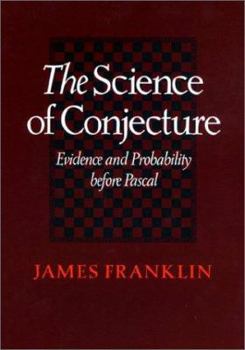
The Science of Conjecture: Evidence and Probability before Pascal
No Customer Reviews

Select Format
Select Condition 
Book Overview
Before Pascal and Fermat's discovery of the mathematics of probability in 1654, how did we make reliable predictions? What methods in law, science, commerce, philosophy, and logic helped us to get at the truth in cases where certainty was not attainable? In this text, James Franklin examines how judges, witch inquisitors, and juries evaluated evidence; scientists weighed reasons for and against scientific theories; and merchants counted shipwrecks to determine insurance rates. Sometimes this type of reasoning avoided numbers entirely, as in the legal standard of proof beyond a reasonable doubt; at other times it involved rough numerical estimates, as in gambling odds or the level of risk in chance events.
Format:Hardcover
Language:English
ISBN:0801865697
ISBN13:9780801865695
Release Date:June 2001
Publisher:Johns Hopkins University Press
Length:512 Pages
Weight:1.90 lbs.
Dimensions:9.8" x 1.3" x 6.5"
Grade Range:Postsecondary and higher
Customer Reviews
0 rating
Copyright © 2026 Thriftbooks.com
Terms of Use | Privacy Policy | Do Not Sell/Share My Personal Information | Cookie Policy | Cookie Preferences | Accessibility Statement
ThriftBooks ® and the ThriftBooks ® logo are registered trademarks of Thrift Books Global, LLC
ThriftBooks ® and the ThriftBooks ® logo are registered trademarks of Thrift Books Global, LLC
