


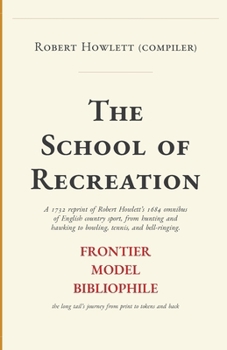
The School of Recreation
No Customer Reviews

First published in 1684 and reprinted here in its 1732 London edition, The School of Recreation is a single-volume compendium of nearly every diversion available to the English country gentleman before the modern sporting press existed. Robert Howlett, a compiler of whom almost nothing personal is known, gathers practical instruction on hunting, hawking, horse racing, fishing, fowling, shooting, fencing, cock-fighting, bowling, tennis, and the peculiarly English art of change-ringing - all rendered in the brisk, declarative voice of an author who assumes the reader will be in the field, the kennel, or the belfry by week's end. The book is a window onto a vanished category of vernacular how-to writing: the gentleman's omnibus that preceded specialization, the sporting magazine, and the codified rulebook. Frontier Model Bibliophile presents the 1732 trade reprint as a facsimile, framed by a Note on the Edition, historical context, and an annotated bibliography tracing the long downstream influence of Howlett's compendium on English sporting literature. The School of Recreation is an omnibus, and that fact is the first thing to register about it. In a single small-format volume of roughly 160 pages, Robert Howlett offers the English country gentleman a working manual for nearly every recognized recreation of his class and century: hunting (the hart, the buck, the hare, the fox), hawking and falconry, the breeding and training of horses for racing and the road, fowling and shooting, fencing with the small-sword, cock-fighting, bowling on closed alleys and open greens, tennis as then played in walled courts, angling for trout and salmon and coarse fish, and - distinctively - the technical art of change-ringing on tower bells. Few categories of period writing pack this many distinct practical literatures between two covers. The book is a snapshot of an English leisure economy before specialization fractured it into separate genres and separate publishers. Its structure is the structure of a country library reduced to one shelf and then to one volume; its voice is the voice of a compiler who expects the reader to put the book down within the hour and walk out to the kennel or the mews. The world Howlett's compendium came out of was the late Stuart and early Hanoverian countryside, in which sport was the daily idiom of the landed class and a meaningful portion of the urban professional class as well. The 1684 first edition appeared in the reign of Charles II, a court that had self-consciously revived field sports after the Interregnum's Puritan austerities. The present 1732 reprint, issued under George II by the London bookseller H. Rhodes, places the work in a moment when sporting print was about to expand into the periodical form (the Sporting Magazine would launch in 1792, Bell's Life in London in 1822) but had not yet done so. Manuals like Howlett's still served as the canonical reference, and the bookseller's decision to set the work in type again, nearly half a century after its first appearance, is evidence that the format continued to sell. The compiler's voice throughout is matter-of-fact, sometimes terse, occasionally drifting into the cant vocabulary of the kennel and the mews - a hart in its sixth year is a Hart, a hare in its second a Hare, a hound's qualities are "suitable to the Country where they are bred." The brisk prose carries an assumption of competence on both sides of the page. For the present-day reader the value of this volume is documentary in the deep sense. It records a category of vernacular knowledge - the gentleman's omnibus of practical recreation - that no longer exists in print culture and could not now be reassembled from any single living source.
Format:Paperback
Language:English
ISBN:B0HG4QWGZ5
ISBN13:9798259506909
Release Date:March 2027
Publisher:Frontier Model Bibliophile
Length:174 Pages
Weight:0.46 lbs.
Dimensions:0.4" x 5.5" x 8.5"
Customer Reviews
0 rating
Copyright © 2026 Thriftbooks.com
Terms of Use | Privacy Policy | Do Not Sell/Share My Personal Information | Cookie Policy | Cookie Preferences | Accessibility Statement
ThriftBooks ® and the ThriftBooks ® logo are registered trademarks of Thrift Books Global, LLC
ThriftBooks ® and the ThriftBooks ® logo are registered trademarks of Thrift Books Global, LLC
