


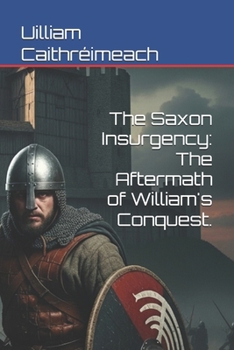
The Saxon Insurgency: The Aftermath of William's Conquest.

The Saxon Insurgency: A Revolutionary Reinterpretation
This comprehensive study fundamentally reframes the Norman Conquest as the beginning of a twenty-year counter-insurgency war rather than a swift military victory. The Saxon resistance from 1066-1086 was far more extensive, sophisticated, and internationally connected than traditionally portrayed, involving systematic military campaigns, diplomatic alliances with Danish, Irish, and Welsh powers, and coordinated cultural preservation efforts across multiple regions.
The book reveals how persistent Saxon resistance forced revolutionary innovations in Norman governance that created the foundations of medieval English government. The massive castle-building program, legal reforms, administrative systems, and territorial control mechanisms developed to suppress resistance became the infrastructure of English political development for centuries. These innovations influenced European political development broadly, making England a laboratory for medieval state-building.
Perhaps most remarkably, Saxon resistance achieved ultimate victory through cultural persistence rather than military success. When armed rebellion failed, Saxon culture survived through language preservation, religious traditions, legal customs, and folk memory, ultimately transforming the conquerors themselves. By 1150, many Norman families had become thoroughly "Anglicized," speaking English and adopting Saxon cultural practices.
The work demonstrates how the supposed "Norman Yoke" actually created a hybrid Anglo-Norman culture that became distinctively English, showing that cultural resistance can achieve what military resistance cannot-the preservation and transmission of identity across generations.
Customer Reviews
ThriftBooks ® and the ThriftBooks ® logo are registered trademarks of Thrift Books Global, LLC
