


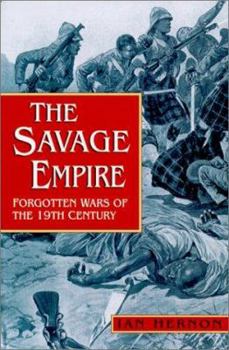
The Savage Empire: Forgotten Wars of the 19th Century

This text, a sequel to Massacre and Retribution, recounts the darker side of some of the forgotten colonial wars. These include the Opium War (1839-42) - which shamed Britain and was fought to... This description may be from another edition of this product.
Format:Hardcover
Language:English
ISBN:0750924802
ISBN13:9780750924801
Release Date:January 2000
Publisher:Sutton Pub Ltd
Length:208 Pages
Weight:1.20 lbs.
Dimensions:9.3" x 0.8" x 6.0"
Customer Reviews
4 ratings
Fascinating Collection of Forgotten Conflicts
Published by Thriftbooks.com User , 16 years ago
The author, Ian Hernon, does an excellent job of condensing these conflicts into short, easy to read narratives. The book contains nine chapters. Each chapter focuses on a different war. In all, the book covers the period from 1824 to 1898. The author uses a writing style that moves quickly. The reader will not be bored or bogged down by excess detail. That said, this is not a book for people interested in detailed descriptions of these events. The author augments his narrative with newspaper reports taken from this period. Journalists were frequently embedded with the field forces. As a result, they were often the source of much detailed information on these wars. The use of these newspaper excerpts adds a nice touch to the narratives. The book contains numerous black and white pictures of this period which provide a great visual aid to the reader. The portraits do a nice job of putting a face to the various names. Some of the battle drawings were made by illustrators employed by the newspapers. These drawings do an excellent job of bringing the difficult terrain and the ferocity of the battles to life. Unfortunately, the book contains only a few geographic maps which contain minimal detail. There are no battle maps. The battle narratives are also lacking in detail. That said, the author does describe the events or causes of the individual conflicts. All in all, this is a well written book. Although lacking in detail, it does provide a nice overview of these wars. The various narratives move quickly and the reader will gain a good understating of these forgotten wars.
Fascinating Historical Tour
Published by Thriftbooks.com User , 22 years ago
Whether you are a serious military historian, or a casual reader of history in general, you will thoroughly enjoy this read. British 19th Century military history is a fascinating subject, what with brave men being sent to exotic foreign lands and engaging in brutal combat with the savage inhabitants of same, the latter of whom were more often than not were simply fighting to protect their land and traditions. The British soldier was actually as much a victim as the natives and indigenous populations that they were sent to fight, what with being subjected to disease, inhospitable climes, inane battle strategies, and the often inept generals that were supposed to guide and protect them, The chapter on the extinction of the native aborigines of Tasmania is especially interesting and is really more about genocide than it is war in the traditional sense. There are two different chapters on two wars with China, both of them imposed on the Chinese so the British could protect their opium trade. Also interesting is the chapter on the Benin Massacre in Africa, where a fetish king propogated human sacrifice on his own subjects, which is about the only expedition in this book that I felt the Brits had made out a righteous case for going to war on. I couldn't put this book down and have since ordered and read Ian Hernon's two other compelling volumes in his trilogy on Britain's forgotten wars, those being Massacre And Retribution and Blood In The Sand. If you like this sort of thing, you should also check out Byron Farwell's book called Queen Victoria's Little Wars, an earlier work that is cited in Hernon's bibliography, and which provides a great overview on the subject in one volume.
Good Imperial History
Published by Thriftbooks.com User , 23 years ago
Hernon continues with the third book in his trilogy of small 19 Century Wars. Besides being a good introduction to obscure, yet intensely interesting sideshows of the British Empire, Hernon takes a theme in each volume and in this one it is the notion of savagery that characterised these engagements. Savagery of the victor and savagery of the conquered. Hernon tires to be objective as he cites the words of a contemporary British politician, calling the Opium War "one of the most shameful acts of agression in our history." The actions of the Royal Navy in the 4 hour shelling of Zanzibar were no doubt directed at a despot and his supporters but that did not mitigate the effect of solid shrapnel and high-explosive against his helpless retainers (many of them children & women). The actions of early white settlers in Tasmania also makes depressing reading indeed and although intuitively one knows that the predations of conquering peoples are everywhere horrible, one cannot help thinking that the unabashed extermination of the Tasmanian Aborigine was one of the more barbaric examples of Man's inhumanity. But this is no politically correct tract for new found leftist sentitment, or those that would believe that all societies waging war against elements of the British Empire were inherently noble.The sacrifice and slave based societies of Africa where Blacks sold there fellow Blacks to other Blacks and Arabs was wiped out by British armed might. Of course citing the leitmotif of anti-slavery was very self-serving to Britain and increasing its markets. It did nonetheless have the resultant effect of wiping out the cruel practise. Also, although the British made money from Opium, it was never as much as those Chinese middlemen who acted as brokers. So the exposition of this savagery, some unmitigated by any redeeming factor, is Hernon's central thesis. His backdrop is the obscure wars for empire where British and Imperial soldiers' bones lay in unmarked graves, in a jungle clearing, a desert, or in the waters off some unknown shore. Ian Hernon's writing on these obscure wars is not just interesting, it is a good starting point for anyone wanting to get a better idea of how imperialism waged a war on "savages" (a term that seems to have been used as much in the 19th Century as the term "terrorist" is used nowadays) -- in far flung places: punative expeditions to far-off lands, fortified camps and naval blockades to isolate and capture insolent natives and unruly despots. Seems that some things do not change.
Far-Flung Lands
Published by Thriftbooks.com User , 24 years ago
The amazing thing about the British Empire, as shown by Hernon's masterful depictions of its various skirmishes, is the scale of the enterprise. Redcoats (and later khaki-coats) were fighting in Buenos Aires (1805), Burma (1820s-60s), China (1836, 1856), Tasmania (1840s), Iran (1857), Zanzibar (1890s) and Nigeria. Albion's soldiers exhibited individual bravery and heroism to fill the annals of miliitary glory, but the political motives weren't always worthy and the results of the campaign were often tragic. The "Black War" against Tasmanian aborigines is a lasting blight upon both the Australian and British reputations. Despite contemporary protestations to the contrary, the Opium Wars nourished the drug trade. Britain would also rather forget the raid on Buenos Aires, an unmitigated disaster for its troops and ships - although it did indirectly contribute to Latin American independence. A fine account of oft-neglected history.
Copyright © 2026 Thriftbooks.com Terms of Use
| Privacy Policy | Do Not
Sell/Share My Personal Information | Cookie Policy | Cookie Preferences | Accessibility Statement
ThriftBooks® and the ThriftBooks® logo are registered trademarks of Thrift Books Global, LLC
ThriftBooks® and the ThriftBooks® logo are registered trademarks of Thrift Books Global, LLC
