


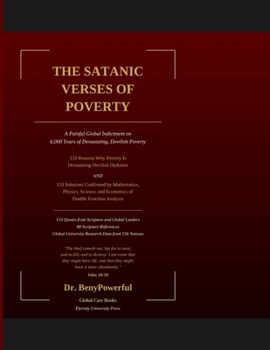
The Satanic Verses of Poverty!

THE GLOBAL DATA OF DISA: A STATISTICAL PORTRAIT OF 6,000
YEARS OF DEVASTATION
"If any provide not for his own, and specially for those of his own
house, he hath denied the faith, and is worse than an infidel."
- 1 Timothy 5:8 (KJV)
Before the 153 reasons are enumerated, the global data must be confronted in its totality.
The statistics that follow are not abstractions - they are the vital signs of a civilization in moral
cardiac arrest. Every number represents a name. Every percentage point represents a million lives.
Every trend line traces a trajectory of human suffering or human liberation. The data are the
evidence. Let it speak.
THE EXTREME POVERTY CRISIS: According to the World Bank's Poverty and
Inequality Platform, updated in September 2025, an estimated 839 million people lived in extreme
poverty in 2024, defined as subsistence on less than $3.00 per day at 2021 purchasing power parity.
This represents 10.3 percent of the global population - an upward revision of approximately 22
million people from the previous estimate, reflecting new survey data from Nigeria and improved
methodology for estimating poverty in countries without direct data. In June 2025, the World Bank
raised the international poverty line from $2.15 to $3.00, based on updated price comparisons from
the International Comparison Program. Under the new threshold, approximately 125 million
additional people are classified as extremely poor - not because the world became poorer, but
because the measurement now more accurately captures what it means to survive on the margins of
existence.
The regional distribution of extreme poverty is a geography of injustice. Sub-Saharan
Africa bears the heaviest burden, with an extreme poverty rate of approximately 45.5 percent in
2022 under the new poverty line - meaning nearly half the population of the continent survives on
less than $3.00 per day. Eastern and Southern Africa face the most severe conditions. The Middle
East and North Africa region, which now includes Afghanistan and Pakistan under the World
Bank's revised regional classification, has the second-highest poverty rate at roughly one in eight
people. By 2025, more than three-quarters of the global extreme poor will live either in Sub-
Saharan Africa or in fragile and conflict-affected countries - places where war, governance
failure, and institutional collapse compound economic deprivation.
MULTIDIMENSIONAL POVERTY: Income poverty tells only part of the story. The
UNDP's 2025 Global Multidimensional Poverty Index measures poverty across ten indicators in
three dimensions: health (nutrition and child mortality), education (years of schooling and school
attendance), and living standards (cooking fuel, sanitation, drinking water, electricity, housing, and
assets). Across 109 countries, 1.1 billion people are multidimensionally poor - suffering
deprivation in at least one-third of these indicators simultaneously
Customer Reviews
ThriftBooks ® and the ThriftBooks ® logo are registered trademarks of Thrift Books Global, LLC
