


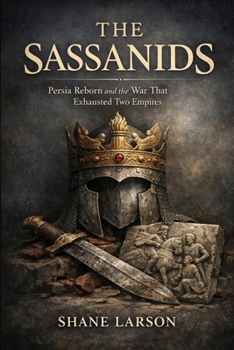
The Sassanids: Persia Reborn and the War That Exhausted Two Empires

In AD 260 a Roman emperor was captured alive on the battlefield-the only one in a thousand years of Roman history-and the king who took him carved the scene into a cliff above the tombs of Darius and Xerxes.
The emperor was Valerian. He was never ransomed and never rescued; he grew old in captivity and died there, and Rome, which recorded everything, kept a shocked silence about it. The king was Shapur I of the house of Sasan, and the carving was a claim: that his dynasty was the empire of Cyrus and Darius restored after five hundred years of interruption, and that Persia was itself again. Rome had spent three centuries fighting Parthians it usually beat. It would spend the next four fighting Persians it could not.
This is the story of the last Persian empire of antiquity, told from the inside-the state church wealthy enough to depose kings, the engineered rivers that made Mesopotamia the richest land on earth, the armored cavalry Rome studied and copied, the tax reform that outlived the empire itself. For four hundred years the two superpowers fought over the same three hundred miles of frontier. Both sacked the other's greatest cities. Both reached the other's capital. Neither could keep what it took.
Then came the greatest war of the ancient world that almost nobody has heard of. Between 602 and 628, Persian armies took Syria, Jerusalem, and Egypt, carried off the True Cross, and camped within sight of the walls of Constantinople-until the emperor Heraclius abandoned his besieged capital and marched into the Persian heartland instead. When it ended, both empires had won nothing and spent everything. Within a decade, Arab armies out of the peninsula destroyed one of them completely and took the richest half of the other. Two empires exhausted each other for four centuries, and a third party won.
What you'll learn:
How a vassal family from the hills of Fars overthrew an empire and claimed a five-hundred-year-old inheritanceWhat actually happened to Valerian and the Roman army taken with him-and what the Persians did with tens of thousands of Roman prisonersHow Zoroastrianism became history's first true state church, with a chief priest who could unmake kingsWhy the fortress frontier-Nisibis, Amida, Dara-never moved in four hundred years of warHow Khosrow I's reforms made a Persian king the model of justice for the civilization that destroyed his empireThe war of 602-628, campaign by campaign: Jerusalem taken, Constantinople besieged, and the most improbable counterattack in Roman historyWhy neither empire could have been conquered in 600-and why both could be in 636This book is for you if:
You have read plenty of Roman history and only ever seen Persia from the outsideYou want military history with the machinery behind it-taxes, priests, canals, and succession politics, not just battlesYou like a book that argues a real thesis and shows its evidence: the kings' own inscriptions, the coins, the seals, the enemy's chroniclesYou want to understand how one of the most consequential decades in world history became possibleRome's most dangerous enemy finally gets its own book. Read the four-hundred-year war from the other side of the frontier.
Customer Reviews
ThriftBooks ® and the ThriftBooks ® logo are registered trademarks of Thrift Books Global, LLC
