


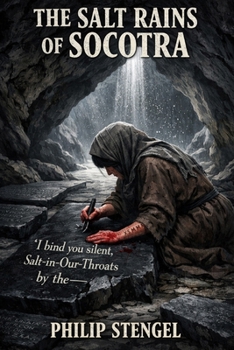
The Salt Rains of Socotra

On Socotra, teacher Layla al-Salim has spent her life preserving what the island carries in speech: old words, family lines, songs, wind names, and the living memory that keeps a people intact. Then the sky turns white and begins raining salt. At first the fall looks almost delicate. By nightfall it is burning skin, poisoning water, and doing something worse than physical harm. It is taking words out of living mouths. Children forget terms they learned that morning. Elders lose names that held entire family histories together. And every missing word leaves the world around it slightly changed, as if reality itself prefers the silence.
As Layla fights to record what the village is losing, she discovers the catastrophe is older than weather and more intimate than plague. In hidden stones, broken phrases, and the failed work of a woman named Asma, the island's past reveals itself: a buried binding, a devouring presence called Salt-in-Our-Throats, and an older rule the grandmothers preserved in fragments after language itself began to collapse. The salt does not simply erase. It edits, smooths, and teaches people how to live around absence until forgetting feels natural.
What follows is not only survival horror, but a battle over speech, memory, and the right to remain a people under pressure. The Salt Rains of Socotra is folkloric psychological horror about linguistic erasure, island memory, and the terror of discovering that some silences do not descend when the world goes quiet. They are cultivated, one missing word at a time.
Customer Reviews
ThriftBooks ® and the ThriftBooks ® logo are registered trademarks of Thrift Books Global, LLC
