


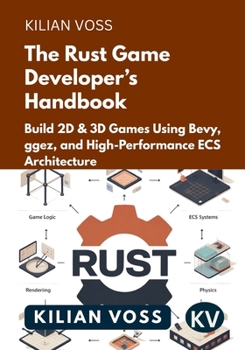
The Rust Game Developer's Handbook: Build 2D & 3D Games Using Bevy, ggez, and High-Performance ECS Architecture

The Rust Game Developer's Handbook is a comprehensive, systems-focused guide to building high-performance 2D and 3D games in Rust using modern, production-ready tools such as Bevy, ggez, and Entity Component System (ECS) architecture. Written for developers who want depth rather than demos, this book takes you from core Rust concepts to shipping optimized, cross-platform games.
Rust brings together memory safety, zero-cost abstractions, and predictable performance-qualities that are especially powerful in game development. This book shows you how to apply those strengths in real engines and real projects. You will learn how real-time game loops work, how ECS enables cache-friendly and parallel execution, and how data-oriented design leads to scalable, maintainable game systems.
The book begins by teaching Rust fundamentals through a game-development lens, covering ownership, borrowing, lifetimes, error handling, and performance-critical memory layout. From there, it moves into real-time programming essentials such as delta time, fixed-step simulation, event-driven systems, and frame performance management.
You will build complete games using ggez for 2D development and Bevy for both 2D and 3D projects. Along the way, you will work with rendering pipelines, input systems, asset management, collision detection, physics integration, audio systems, WGSL shaders, texture and mesh optimization, and runtime asset streaming. Advanced chapters explore ECS internals, parallel system scheduling, serialization of ECS worlds, and engine-level architectural patterns used in professional game development.
The final part of the book focuses on production realities that many resources overlook: testing and debugging ECS systems, profiling CPU and memory usage, optimizing performance, building for desktop and web with WASM, managing assets in deployment, and distributing finished games across platforms.
This book is for software developers, systems programmers, and serious game creators who want to understand not just how to make games in Rust, but why modern engines are designed the way they are. Every chapter emphasizes clarity, correctness, and real-world application, making this handbook a lasting reference for building fast, safe, and scalable games in Rust.
If you want to master Rust game development from engine fundamentals to final release-without fluff, outdated practices, or shallow coverage-this book provides the complete, practical path forward.
Customer Reviews
ThriftBooks ® and the ThriftBooks ® logo are registered trademarks of Thrift Books Global, LLC
