


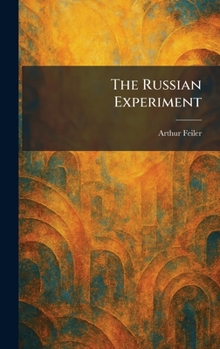
The Russian Experiment

"The Russian Experiment" provides a rigorous and insightful analysis of the early Soviet state during a period of radical socio-economic transformation. Written by the respected economist and journalist Arthur Feiler, this work offers a contemporary perspective on the Bolshevik effort to completely restructure Russia's social and economic foundations in the late 1920s and early 1930s. The book focuses heavily on the mechanics and ambitions of the First Five-Year Plan, examining the drive toward rapid industrialization and the massive collectivization of agriculture.
Feiler's observations go beyond mere statistics to explore the lived reality of a population caught in the midst of an unprecedented political project. He examines the tension between revolutionary ideology and the practical challenges of state-wide economic planning, offering a nuanced view of the successes, failures, and human costs associated with the Soviet system's formative years. As a historical document, this study remains an essential resource for those interested in the evolution of socialist thought, the history of the USSR, and the broader global impact of the Russian Revolution. "The Russian Experiment" captures the intensity of a nation in flux, providing a vital window into one of the most significant political developments of the twentieth century.
This work has been selected by scholars as being culturally important, and is part of the knowledge base of civilization as we know it. This work was reproduced from the original artifact, and remains as true to the original work as possible. Therefore, you may see the original copyright references, library stamps (as most of these works have been housed in our most important libraries around the world), and other notations in the work.
This work is in the public domain in the United States of America, and possibly other nations. Within the United States, you may freely copy and distribute this work, as no entity (individual or corporate) has a copyright on the body of the work.
As a reproduction of a historical artifact, this work may contain missing or blurred pages, poor pictures, errant marks, etc. Scholars believe, and we concur, that this work is important enough to be preserved, reproduced, and made generally available to the public. We appreciate your support of the preservation process, and thank you for being an important part of keeping this knowledge alive and relevant.
Customer Reviews
ThriftBooks ® and the ThriftBooks ® logo are registered trademarks of Thrift Books Global, LLC
