


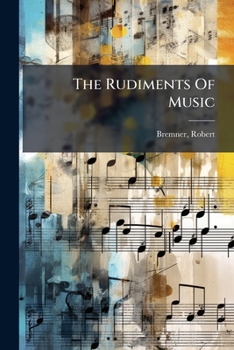
The Rudiments Of Music: Or, A Short And Easy Treatise On That Subject. To Which Is Annexed, A Collection Of The Best Church-tunes, ... The Second Edit

"The Rudiments Of Music, Or, A Short And Easy Treatise On That Subject" by Robert Bremner, offers a comprehensive introduction to the fundamentals of music theory. This second edition, published in 1762, includes significant additions, enhancing its value as a practical guide for aspiring musicians. Bremner's treatise is designed to be accessible, making it an ideal resource for those new to the study of music.
In addition to theoretical instruction, the book features a collection of esteemed church tunes, providing valuable musical examples for study and performance. This combination of theory and practical application reflects the musical practices of the 18th century and offers insights into the era's musical tastes and standards.
Bremner, a notable figure in the musical landscape of his time, presents a work that remains relevant for its clarity and historical significance. "The Rudiments of Music" is a valuable resource for students, scholars, and anyone interested in understanding the foundations of music and the rich tradition of church music.
This work has been selected by scholars as being culturally important, and is part of the knowledge base of civilization as we know it. This work was reproduced from the original artifact, and remains as true to the original work as possible. Therefore, you will see the original copyright references, library stamps (as most of these works have been housed in our most important libraries around the world), and other notations in the work.
This work is in the public domain in the United States of America, and possibly other nations. Within the United States, you may freely copy and distribute this work, as no entity (individual or corporate) has a copyright on the body of the work.
As a reproduction of a historical artifact, this work may contain missing or blurred pages, poor pictures, errant marks, etc. Scholars believe, and we concur, that this work is important enough to be preserved, reproduced, and made generally available to the public. We appreciate your support of the preservation process, and thank you for being an important part of keeping this knowledge alive and relevant.
Customer Reviews
ThriftBooks ® and the ThriftBooks ® logo are registered trademarks of Thrift Books Global, LLC
