


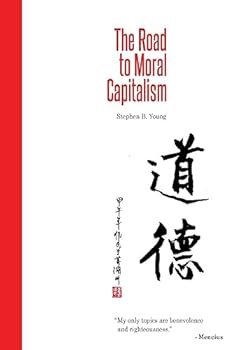
The Road to Moral Capitalism
No Customer Reviews

The book exposes several core fallacies holding up modern financial free-market orthodoxy and which contributed to the recurrent failures of banking and finance to sustain healthy economic growth for all. The book argues that:1) It is wrong to oppose public goods to private goods, with public goods consigned togovernments for distribution and private goods left to allegedly only self-serving free markets.Some notional public goods - education, social services, transportation, etc. - can be effectivelysourced and delivered by markets. And, to the contrary, some private goods affect the publicinterest and so draw upon themselves aspects of public goods. There is a continuum of goodsand services ranging from pure public goods to pure private goods, with intermediate goods of amixed character. Quasi-public goods and quasi-private goods can be provided by privateenterprise through open market transactions. These are shared value goods and services.Financial intermediation is such a mixed public and private good.2) Corporate social responsibility performs a mediation function between private goods andservices provided by the firm and public goods demanded by society.3) A limited theory of valuation - which ignores intangible assets and liabilities - caused theasset bubble and resulting collapse of leverage in the fall of 2008. A better theory of valuation isproposed to add public good dimensions to the calculation of private asset values.4) The existence of an agency problem in finance and corporate governance is challenged.Current agency theory presumes that markets are incapable of providing public goods. Theassumed agency problem supports companies ignoring stakeholders, externalities and fiduciaryduties of responsibility.5) Anxiety and money exacerbate the selfishness which brings the agency problem to the fore, but they can be offset by enhancing the strength of the moral sense, which is part of eachperson's social-psychology. The severity of the agency problem is rejected by value-basedcultures - Catholic social teachings, Buddhism, Chinese ethics, Taoism, Aristotle and Qur'an. Inaddition, I/Thou relationships and friendships sustain values to overcome the agency problem.6) Financial institutions need to be incentivized to provide public goods in addition to privategoods. 7) "Wall Street" may be more about rent-extraction than investing in real growth. In much of finance, contract rights - shares, bonds, loan participations, derivatives, etc. - are only "rented" for a short time in order to flip them for a higher price. Why, then, should traders be given all the respect due to owners who invest for the long-term?8) The US Dodd-Frank reforms did not challenge the inherent dysfunction in financial trading, but only sought to distance public coffers from responsibility for making good on private losses.9) It is self-restraint - the moral sense as provided to each of us by Natural Law - which canalign private goods with public good and so lead us to a moral capitalism
Format:Paperback
Language:English
ISBN:194176889X
ISBN13:9781941768891
Release Date:June 2015
Publisher:Waterside Productions, Incorporated
Length:276 Pages
Weight:0.90 lbs.
Dimensions:0.6" x 6.0" x 9.0"
Customer Reviews
0 rating
Copyright © 2026 Thriftbooks.com Terms of Use
| Privacy Policy | Do Not
Sell/Share My Personal Information | Cookie Policy | Cookie Preferences | Accessibility Statement
ThriftBooks® and the ThriftBooks® logo are registered trademarks of Thrift Books Global, LLC
ThriftBooks® and the ThriftBooks® logo are registered trademarks of Thrift Books Global, LLC
