


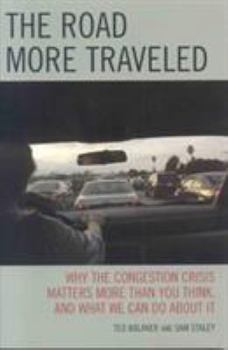
The Road More Traveled: Why the Congestion Crisis Matters More Than You Think, and What We Can Do About It

Select Format
Select Condition 
Book Overview
Though often dismissed as a minor if irritating nuisance, congestion's insidious effects constrain our personal and professional lives, making it harder to find a good job, spend time with our family, and maintain profitable businesses. After centuries of building our cities into bustling centers of commerce and culture, we are beginning to slow down. The Road More Traveled shines a new light on the problem of traffic congestion in this easily accessible book. You'll learn how we can reclaim our mobility if we are willing to follow successful examples from overseas, where innovations in infrastructure and privatization have made other nations stronger and more competitive. By thoroughly debunking the myths that keep our policy makers trapped in traffic, the book argues that we can and should build our way out of congestion and into a fast-paced future.
Format:Hardcover
Language:English
ISBN:0742551121
ISBN13:9780742551121
Release Date:September 2006
Publisher:Rowman & Littlefield Publishers
Length:208 Pages
Weight:0.90 lbs.
Dimensions:9.4" x 0.7" x 6.4"
Customer Reviews
3 ratings
Common Sense comes to solving traffic congestion!
Published by Thriftbooks.com User , 18 years ago
This book could save us a Billion dollars! (Or more) First, I must give you some background on why I was frantically looking for a well written, fact packed book on the cost benefits of rail vs. highways and which one makes the most sense in terms of cost, convenience, efficiency, safety and actual usage. In Madison, Wisconsin our "Mayor Dave" and our Dane County Executive recently "announced an agreement" at a press conference in June 07. The announcement was the two of them had decided for a county of 450,000 people to go ahead with plans for a commuter rail plan for Madison and two closeby towns AND a Trolley system for downtown Madison only. The Commuter rail system is to use the surface rail tracks (not subway or elevated) laid down in the post Civil War era when there were no autos, trucks, and busses and few roads! Ignoring this fact and even admitting in the Transport 2020 report that a rail system would "likely increase traffic congestion" they decided they wanted a Train and a Trolley too! The cost? Estimates for the build-out are around a billion dollars. Who pays? You know...Taxpayers at all levels. Locally another 1/2 per cent added to our 5.5% sales taxes- already above the rest of the state - to raise $46 Million a year forever to subsidize the rail system. Moreover, like the movie "Dumb and Dumber" my Mayor Dave made a second choice. How about another $250,000 (start up costs only) for his favorite toy - a couple of miles of Trolley system that he knew the County taxpayers would be happy to support. (Even though they would likely never use it) Note: The Mayor and the County Executive are nice people and they are not dumb, but the rail and trolley plans being proposed certainly are! Now you know why I bought this book! The authors are experts. Their writing is clear, concise and reads like Ben Franklin's Almanacs. Common sense rules as does straight shooting facts and concrete advice you can use to fight the Rail policy Wonks and elites who would like to give their kids a ride on a train.... once. Examples: "Ten Congestion Busters", "Ten Myths of dealing with Traffic Congestion" and "Ten Steps to Congestion Relief". Granted they look like cold remedies, but are practical traffic congestion solutions. Just these three provide you with talking points to take to the City council, the County Board (which I have already) and State and Federal transportation officials. Locally, we are using "The Road More Traveled" as our Bible in talking to civic groups, on local radio and TV, Web sites and Blogs to wake people up to the boondoggle that this plan for a Regional Transportation Authority (RTA) actually will impose on everyone. "The Road" gives you practical solutions to offer to counter the "Rail Heads." Two words of advice: "Buy it"
Clear-Headed Insight into a Crucial Issue
Published by Thriftbooks.com User , 19 years ago
If this book were nearly unreadable and merely served to make its point in dense prose, it would be well worth its price and then some for making a common sense point that has been given short shrift in planning debates. Luckily for us, however, the authors have produced an emminiently accessible work that allows any reasonably literate person with or without a degree in urban planning to have a better understanding of how mobility profoundly affects all of our lives and how our mobility has become constrained over the past few decades by a combination of well-intentioned but poor urban planning and outright congestion-by-design. The authors key point is a simple one: mobility matters. It matters economically and it matters socially. The ability of citizens of modest means to travel expeditiously and cheaply opens up to those citizens a wider range of job opportunities and social interactions than would otherwise be available. Mobility makes our economy richer and social lives more fulfilling. Part of the promise of a free society can only be obtained if we are free to navigate the physical landscape on which that society exists. Your ability to travel 10 miles or 25 miles or 50 miles to commute, to shop to visit friends and relatives, makes your life richer than it would be if your freedom of movement were limited to narrow corridors or tight spheres. A couple of examples: the authors point to dating patterns in a large metropolitan area which have been limited to realtively tight geographic areas due to the hassle that navigating traffic congestion poses to the process of looking for mates further afield. Simply put: A person won't seek to date whom he or she cannot easily reach. This point is further brought home in the case of two income-earner households who have to balance career choices with the demands of conflicting commutes. Ideally, both spouses/partners would take the job that provides him/her with the greatest individual benefits, allowing both to achieve maximum income and job satisfaction. Where mobility constraints require a person to design a career around a commuting pattern it becomes very difficult for both spouses/partners to maximize career opportunities. The authors make an important and common sense point that is nontheless viewed as controversial in our day and age. To wit: no device enhances personal mobility more than an automobile. For some reason I cannot understand, the automobile has come to be viewed as an evil to be tolerated and not as a tool that has enabled the widest possible share of the population to take full advantage of the range of economic and social opportunities open to those who can physically access them. Instead planners and activists have foisted on the general populace the notion that we are "addicted" to the automobile and must be incentivized or coerced into living in extreme density and travelling on fixed rail. The most powerful cudgel these elements have to force the ge
Policy Makers Need to Read this book - the public wants roads
Published by Thriftbooks.com User , 19 years ago
This is an important book for planners, planning commission members, staff and elected officials to read -- especially for anyone involved in the policy-making, planning or approval side of the road construction business. It offers a general apologetic for the value of mobility, independence and flexibility. It argues eloquently that congestion is an evil to be avoided. Its two hardest-hitting chapters are an eloquent defense of suburbia (debunking ten myths) and an exposé on the "congestion coalition" which has perversely encouraged and acquiesced in congestion in the misguided belief that "it's good for us." The chapter on the "congestion coalition" has some interesting analysis on that ubiquitous planning agency known as an "MPO." But by far the most valuable section of the book is its four chapters of real-world examples and practical suggestions. The authors draw our attention to the innovative ways in which massive public projects are being planned and financed overseas, with some suggestions on how those techniques might be used in the US. There is a fascinating chapter on how Houston "built its way out of congestion." -- and an equally fascinating chapter on the success of variable tolling on the 91 Express Lanes in Orange County, California. Chapter 10 offers a variety of practical suggestions on how to tame congestion. Suggestion one: "Build sufficient road capacity to handle the growth in travel demand." The last chapter is a clarion call to action. It lays out Ten Steps to Congestion Relief beginning with "Admit that Mobility is good" and ending with a challenge to "Take the Long View." The notion that we cannot build our way out of congestion is wrong. It's wrong historically, and it's wrong technically. Projects in the United States and around the world show us over and over again that we have the engineering capabilities to build new capacity and manage existing networks more effectively. Congestion has risen to stifling levels because we have failed locally and nationally to make mobility a public-sector priority. It's time to reestablish mobility as a priority for transportation policy at the national, state, and local levels. Moreover, it's important to realize that zero gridlock is a viable goal for regional transportation planning. We have the tools. Public opinion supports it. The funding is there to put meaningful strategies in motion and implement real solutions. What we lack is the leadership to make it happen. "America never has permanent shortages," frustrated Texas legislator Mike Krusee observes, "except in one thing: transportation. Many Americans think congestion is inevitable; it is not. It is a breadline, it is un-American, and we should not tolerate it." It's time now to put the right strategies in place to improve mobility for everyone and eliminate congestion in America's cities. (page 177) Without endorsing every suggestion made by the authors, I nonetheless encourage as many as possible to read and reflec
Copyright © 2026 Thriftbooks.com Terms of Use
| Privacy Policy | Do Not
Sell/Share My Personal Information | Cookie Policy | Cookie Preferences | Accessibility Statement
ThriftBooks® and the ThriftBooks® logo are registered trademarks of Thrift Books Global, LLC
ThriftBooks® and the ThriftBooks® logo are registered trademarks of Thrift Books Global, LLC
