


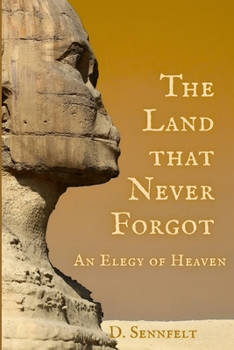
The River That Never Forgot: Egypt as a Memorial of Paradise

Egypt has been studied longer than any other civilisation in human history. Its hieroglyphs have been decoded, its monuments surveyed to the millimetre, its gods catalogued and cross-referenced and compared with every neighbouring pantheon. Two centuries of Egyptology have produced a scholarship of extraordinary precision and depth. And still no one has been able to answer the question that the Nile valley's monuments quietly, insistently, persistently ask: what were they actually built for?
The archaeologists have answered with power. The astronomers have answered with alignments. The mythologists have answered with symbol systems whose origins they cannot locate. None of them has answered with the one thing that makes every temple, every pyramid, every god suddenly, completely, and devastatingly legible: the geography.
The River That Never Forgot is the book that answers the question. Not with speculation or religious enthusiasm - with a geological, astronomical, and archaeological argument built from the African Humid Period's lake sediment cores and the pyramid shafts' stellar targets and the Nile valley's zodiacal geography, that traces the complete knowledge system of a drowned Afar civilisation from its origin above a paleolake to its deliberate encoding in the monuments of the Nile - and shows, temple by temple, god by god, what Egypt was, why it was built, and what it has been saying for five thousand years.
Related Subjects
HistoryCustomer Reviews
ThriftBooks ® and the ThriftBooks ® logo are registered trademarks of Thrift Books Global, LLC
