


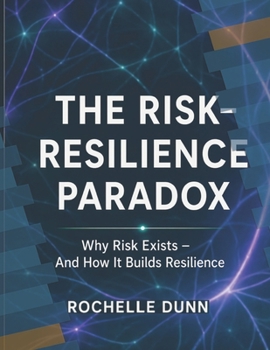
The Risk-Resilience Paradox

Why do people continue behaviours we know are harmful-even when support is in place?
Why do well-intentioned plans fail the moment stress increases?
And why do systems designed to reduce risk sometimes make it worse?
This book answers those questions by challenging one of the most deeply held assumptions in human services: that risk is something to eliminate.
Drawing on over two decades of frontline experience across child protection, out-of-home care, family violence, and community services, Rochelle Dunn introduces a powerful reframe-risk is not just danger to be controlled, but often an adaptive response to survive.
At the heart of this book is the Risk-Resilience Paradox:
the very behaviours we try to stop are often the ones that have kept people safe.
Through this lens, Dunn unpacks the critical distinctions between:
Risk (what we see)Capacity (what is possible in the moment)Capability (what can be built over time)When these are misunderstood, plans become unrealistic, interventions escalate harm, and practitioners are left navigating impossible expectations. When they are understood, responses become more effective, ethical, and sustainable.
This is not a theory-heavy text removed from practice. It is a practical, trauma-informed guide designed for real-world decision-making under pressure. Inside, you'll find:
Clear frameworks to differentiate danger from distressTools to design capacity-matched responses that actually work under stressGuidance on using harm minimisation as a bridge-not a failureStrategies for writing defensible reports that reduce punitive responsesLanguage tools to shift from deficit-based assessments to capability-informed descriptionsDecision-making frameworks to help you know when to push, pause, or escalateEthical guidance for working within mandated, high-risk systems without causing harmMore than anything, this book supports practitioners to work in the grey zone-where safety and autonomy, risk and dignity, urgency and understanding must all be held at once.
Whether you are a social worker, youth worker, psychologist, educator, or leader, this book will change how you interpret behaviour, design interventions, and advocate within systems.
Because people do not let go of what kept them alive...
until something safer is genuinely available.
This book will help you build that "something safer."
Customer Reviews
ThriftBooks ® and the ThriftBooks ® logo are registered trademarks of Thrift Books Global, LLC
