


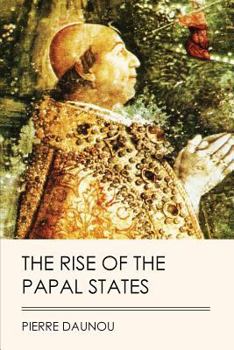
The Rise of the Papal States (Jovian Press)
No Customer Reviews

WHOEVER has read the Gospel, knows that Jesus Christ founded no temporal power, no political sovereignty. He declares that his kingdom is not of this world; he charges his apostles not to confound the mission he gives them, with the power exercised by the princes of the earth. St. Peter and his colleagues are sent not to govern but to instruct and the authority with which they are clothed, consists only in the knowledge and the benefits they are to bestow. Faithful to confining themselves within the bounds of so pure an apostolat, far from erecting themselves into rivals of the civil power, they, on the contrary, proclaimed its independence and the sacredness of its rights: obedience to sovereigns is one of the first precepts of their pious morality. To resist governments is, they say, to offend the Ruler of the world, and take up arms against God himself. The successors of the apostles for a long time held the same language: they acknowledged no power superior to that of sovereigns but Divine Providence itself. They subjected to kings all the ministers of the altar, levites, pontiffs, evangelists, and even prophets. God alone was, immediately and without mediator, the only judge of kings; to him alone belonged their condemnation: the Church addressed to them only supplications or respectful advice. She exercised empire only through the medium of her virtues and possessed no other inheritance than that of faith. These are the very expressions of the holy fathers, not only during the three first centuries, but subsequent to Constantine, and even after the time of Charlemagne. Every one knows, that previous to Constantine, the Christian churches had been but individual associations, too frequently proscribed, and at all times unconnected with the state. The popes, in these times of persecution and of ferment, most assuredly were far from aspiring to the government of provinces: they were contented in being permitted to be virtuous with impunity; and they obtained no crown on earth save that of martyrdom. From the year 321, Constantine allowed the churches to acquire landed property, and individuals to enrich them by legacies. Here we behold, in all probability, says the President Henault, what has given rise to the supposition of Constantine's donation. This donation preserved its credit for such a lapse of time, that in 1478 some Christians were burned at Strasburgh for daring to question its authenticity...
Format:Paperback
Language:English
ISBN:1548223190
ISBN13:9781548223199
Release Date:June 2017
Publisher:Createspace Independent Publishing Platform
Length:214 Pages
Weight:0.64 lbs.
Dimensions:0.5" x 6.0" x 9.0"
Related Subjects
HistoryCustomer Reviews
0 rating
Copyright © 2026 Thriftbooks.com
Terms of Use | Privacy Policy | Do Not Sell/Share My Personal Information | Cookie Notice | Cookie Preferences | Accessibility Statement
ThriftBooks ® and the ThriftBooks ® logo are registered trademarks of Thrift Books Global, LLC
ThriftBooks ® and the ThriftBooks ® logo are registered trademarks of Thrift Books Global, LLC
