


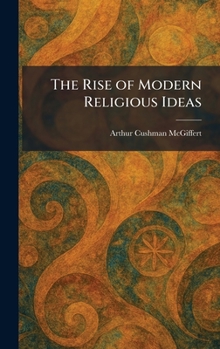
The Rise of Modern Religious Ideas

Select Format
Select Condition 
Book Overview
"The Rise of Modern Religious Ideas" by Arthur Cushman McGiffert offers a comprehensive and scholarly examination of the evolution of Christian thought during the transition into the modern era. McGiffert, a distinguished theologian and historian, traces the disintegration of old dogmatic systems and the subsequent emergence of new religious frameworks influenced by the Enlightenment, modern science, and philosophical advancements.
The work explores key movements such as rationalism, Pietism, and the impact of the physical sciences on traditional belief systems. By analyzing the shift from an external authority-based faith to one grounded in immanent experience and ethical reflection, the book provides vital context for understanding the development of liberal theology. McGiffert identifies the factors-including the growth of democracy and the rise of evolution-that necessitated a reevaluation of the divine relationship with humanity and the world.
Essential for students of church history and the philosophy of religion, this volume serves as an illuminating guide to the intellectual forces that shaped contemporary religious discourse. It remains a significant contribution to the study of how faith adapts and persists in the face of radical cultural and intellectual change.
This work has been selected by scholars as being culturally important, and is part of the knowledge base of civilization as we know it. This work was reproduced from the original artifact, and remains as true to the original work as possible. Therefore, you may see the original copyright references, library stamps (as most of these works have been housed in our most important libraries around the world), and other notations in the work.
This work is in the public domain in the United States of America, and possibly other nations. Within the United States, you may freely copy and distribute this work, as no entity (individual or corporate) has a copyright on the body of the work.
As a reproduction of a historical artifact, this work may contain missing or blurred pages, poor pictures, errant marks, etc. Scholars believe, and we concur, that this work is important enough to be preserved, reproduced, and made generally available to the public. We appreciate your support of the preservation process, and thank you for being an important part of keeping this knowledge alive and relevant.
Customer Reviews
ThriftBooks ® and the ThriftBooks ® logo are registered trademarks of Thrift Books Global, LLC
