


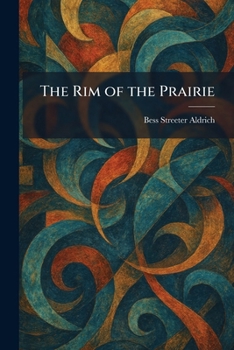
The Rim of the Prairie

Select Format
Select Condition 
Book Overview
"The Rim of the Prairie" is a poignant exploration of identity and heritage set against the sweeping landscape of the American Midwest. The story follows Nancy Moore, a spirited young woman who returns to the small town of Maple City, Nebraska, to visit the elderly couple who raised her. As she navigates the familiar rhythms of prairie life, Nancy grapples with the mystery of her own origins, a secret long guarded by those she loves. Through her encounters with the steadfast Warner Field and the colorful inhabitants of the community, she begins to understand the deep-rooted connections between the land and its people.
Bess Streeter Aldrich masterfully captures the transition between the rugged pioneer era and the modernizing world of the early twentieth century. Rich in atmospheric detail and emotional resonance, the novel celebrates the resilience of the prairie spirit and the enduring importance of home and family. "The Rim of the Prairie" stands as a classic of regional literature, offering a nostalgic yet honest depiction of small-town life and the quiet dramas that define the human experience. With its blend of gentle romance and historical insight, the work remains a testament to the beauty of the Nebraska plains and the strength of the characters who call them home.
This work has been selected by scholars as being culturally important, and is part of the knowledge base of civilization as we know it. This work was reproduced from the original artifact, and remains as true to the original work as possible. Therefore, you may see the original copyright references, library stamps (as most of these works have been housed in our most important libraries around the world), and other notations in the work.
This work is in the public domain in the United States of America, and possibly other nations. Within the United States, you may freely copy and distribute this work, as no entity (individual or corporate) has a copyright on the body of the work.
As a reproduction of a historical artifact, this work may contain missing or blurred pages, poor pictures, errant marks, etc. Scholars believe, and we concur, that this work is important enough to be preserved, reproduced, and made generally available to the public. We appreciate your support of the preservation process, and thank you for being an important part of keeping this knowledge alive and relevant.
Customer Reviews
ThriftBooks ® and the ThriftBooks ® logo are registered trademarks of Thrift Books Global, LLC
