


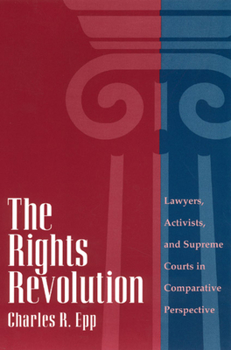
The Rights Revolution: Lawyers, Activists, and Supreme Courts in Comparative Perspective


Select Format
Select Condition 
Book Overview
It is well known that the scope of individual rights has expanded dramatically in the United States over the last half-century. Less well known is that other countries have experienced "rights revolutions" as well. Charles R. Epp argues that, far from being the fruit of an activist judiciary, the ascendancy of civil rights and liberties has rested on the democratization of access to the courts-the influence of advocacy groups, the establishment of governmental enforcement agencies, the growth of financial and legal resources for ordinary citizens, and the strategic planning of grass roots organizations. In other words, the shift in the rights of individuals is best understood as a "bottom up," rather than a "top down," phenomenon. The Rights Revolution is the first comprehensive and comparative analysis of the growth of civil rights, examining the high courts of the United States, Britain, Canada, and India within their specific constitutional and cultural contexts. It brilliantly revises our understanding of the relationship between courts and social change.
Format:Paperback
Language:English
ISBN:0226211622
ISBN13:9780226211626
Release Date:October 1998
Publisher:University of Chicago Press
Length:342 Pages
Weight:1.06 lbs.
Dimensions:0.8" x 6.0" x 9.1"
Customer Reviews
2 ratings
The Rights Revolution
Published by Thriftbooks.com User , 18 years ago
I found this book very helpful in understanding the history of women's rights for a project I'm working on.
Compelling reexamination of rights revolutions
Published by Thriftbooks.com User , 21 years ago
Charles Epp has done something interesting by providing what should have been a self-evident explanation for rights revolution meant to supplement the standard explanations. Conventional wisdom has it that rights revolutions are created either by one or a combination of any of the following: a general rights consciousness in society, a constitutionally entrenched bill of rights, or liberal judges interested in pushing the rights agenda forward. Epp argues that none of these explanations alone sufficiently explain why rights revolutions occur. Instead he argues that a rights revolution depends upon a support structure in civil society able to fund and organize strategic rights litigation. Epp develops this theory by examining the limitations of conventional explanations for the US rights revolution, which began around 1917. After revealing these limitations, Epp examines the creation of the support structure and demonstrates how this more adequately explains the developing rights revolution. Prior to the development of rights oriented groups, the only persons or groups that were able to sustain strategic litigation were businesses. But, beginning in the early 20th century, rights groups developed sufficient funding and organizational capabilities necessary to allow sustained rights litigation. The judicial rights agenda, Epp demonstrates, is directly responsive to these types of litigation strategies. After developing his theory in the US context, Epp tests it through examination of three countries: India, Britain, and Canada. In India we see a country that should, under conventional theories, have experienced a radical rights revolution. Yet, as a result of the weak support structure, no sustained rights agenda emerged. The British example is interesting in that conventional explanations suggest no rights agenda should have emerged, but a limited rights revolution has emerged as a result of the development of specialized rights litigation groups. Epp's examination of Canada debunks the myth that the rights revolution resulted solely from adoption of the Charter in 1982. I said above such an explanation should have been self-evident because the seminal cases defining and creating rights have to start with litigation choices. Yet academic studies have routinely ignored the litigation side of things and focused on courts. This is probably a result of the focus in constitutional studies upon the cases and their results rather than the litigation process that brought the cases up in the first place. Epp's study supplements the conventional explanations for rights revolution and provides a fuller picture than the typical claim that activist judges alone cause such revolutions.
Copyright © 2026 Thriftbooks.com Terms of Use
| Privacy Policy | Do Not
Sell/Share My Personal Information | Cookie Policy | Cookie Preferences | Accessibility Statement
ThriftBooks® and the ThriftBooks® logo are registered trademarks of Thrift Books Global, LLC
ThriftBooks® and the ThriftBooks® logo are registered trademarks of Thrift Books Global, LLC
